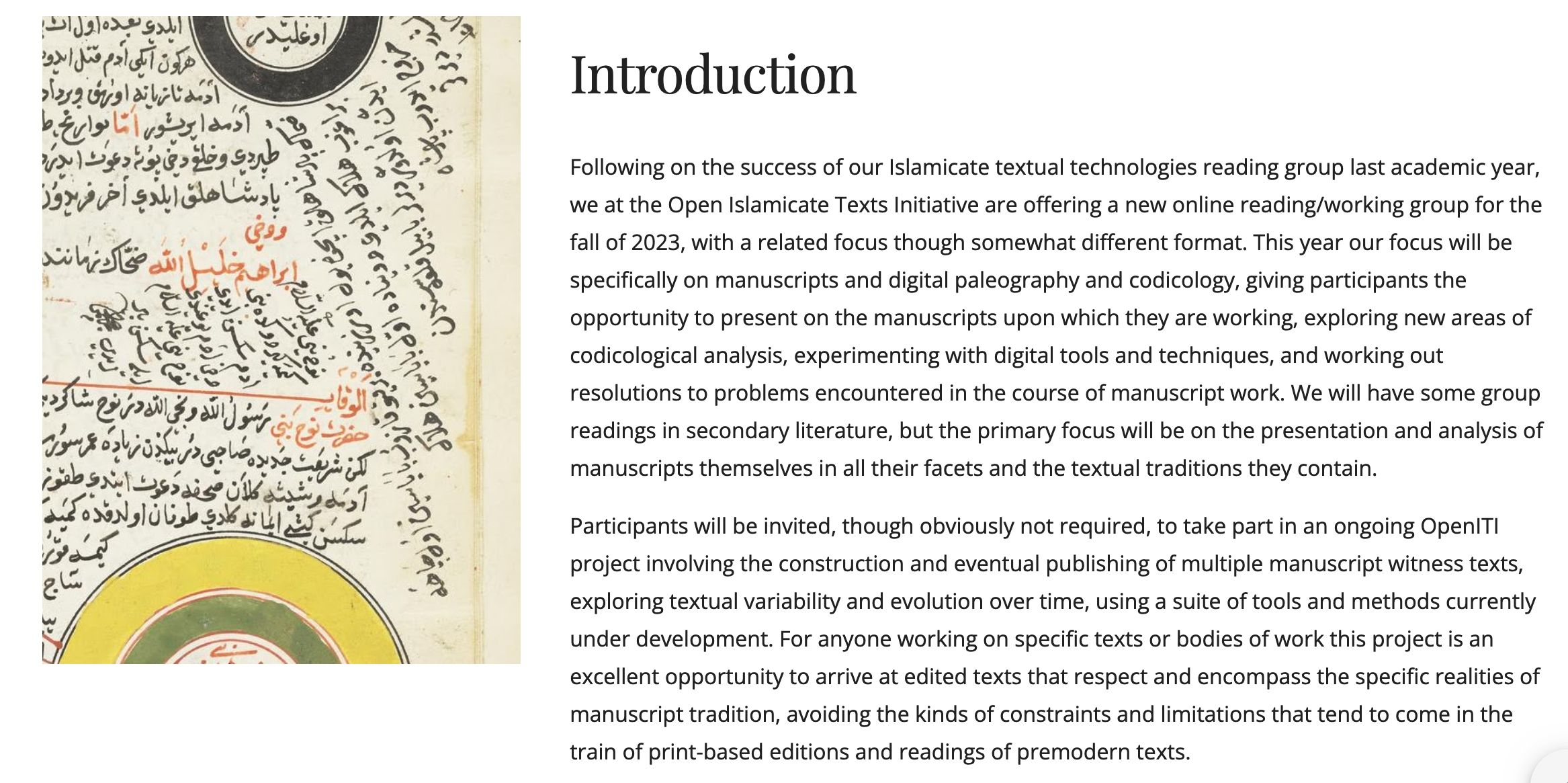
<?xml version="1.0" encoding="utf-8"?><feed xmlns="http://www.w3.org/2005/Atom" xml:lang="en-US"><generator uri="https://jekyllrb.com/" version="4.4.1">Jekyll</generator><link href="/atom.xml" rel="self" type="application/atom+xml" /><link href="/" rel="alternate" type="text/html" hreflang="en-US" /><updated>2025-10-27T18:02:43+00:00</updated><id>/atom.xml</id><title type="html">Open Islamicate Texts Initiative</title><author><name>OpenITI</name></author><entry><title type="html">From Damascus to Istanbul With Our Fall and Spring Ottoman Turkish Reading Group</title><link href="/2025/10/27/From-Damascus-to-Istanbul-With-Our-Fall.html" rel="alternate" type="text/html" title="From Damascus to Istanbul With Our Fall and Spring Ottoman Turkish Reading Group" /><published>2025-10-27T00:00:00+00:00</published><updated>2025-10-27T00:00:00+00:00</updated><id>/2025/10/27/From-Damascus-to-Istanbul-With-Our-Fall-</id><content type="html" xml:base="/2025/10/27/From-Damascus-to-Istanbul-With-Our-Fall.html"><![CDATA[<p>This fall and next spring we are offering two weekly manuscript reading and discussion groups, tackling two very different but equally interesting manuscripts. This post will cover the Ottoman Turkish text and reading group, while a subsequent post will cover the Persian one. Before we get into the details, note that both groups are open to the public and do not require continuous week to week participation but can facilitate occasional “drop-ins.” Ottoman Turkish meets from 10 am to 12 pm (Eastern US time) on Mondays, Persian during the same time slot but on Fridays. Anyone wishing to join can send me an email (<a href="mailto:jallen22@umd.edu">jallen22@umd.edu</a>) and I’ll send out an invite with the Zoom link and other information.</p>

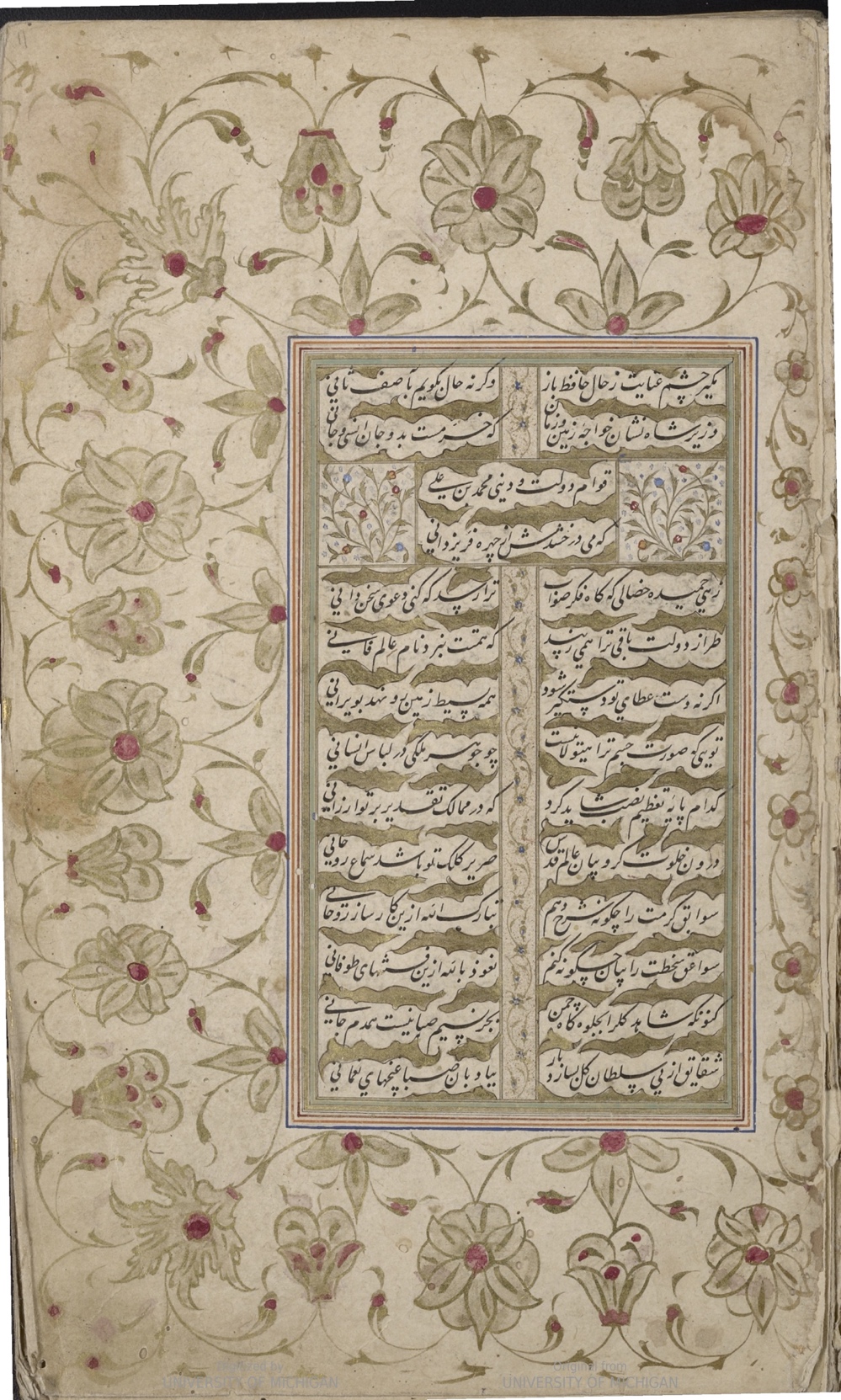
<p><a href="/images/blogs/2025-10-27/From-Damascus-to-Istanbul-With-Our-Fall-Jonathan%20Parkes%20Allen/media/image1.png"><img src="/images/blogs/2025-10-27/From-Damascus-to-Istanbul-With-Our-Fall-Jonathan%20Parkes%20Allen/media/image1.png" alt="" /></a>
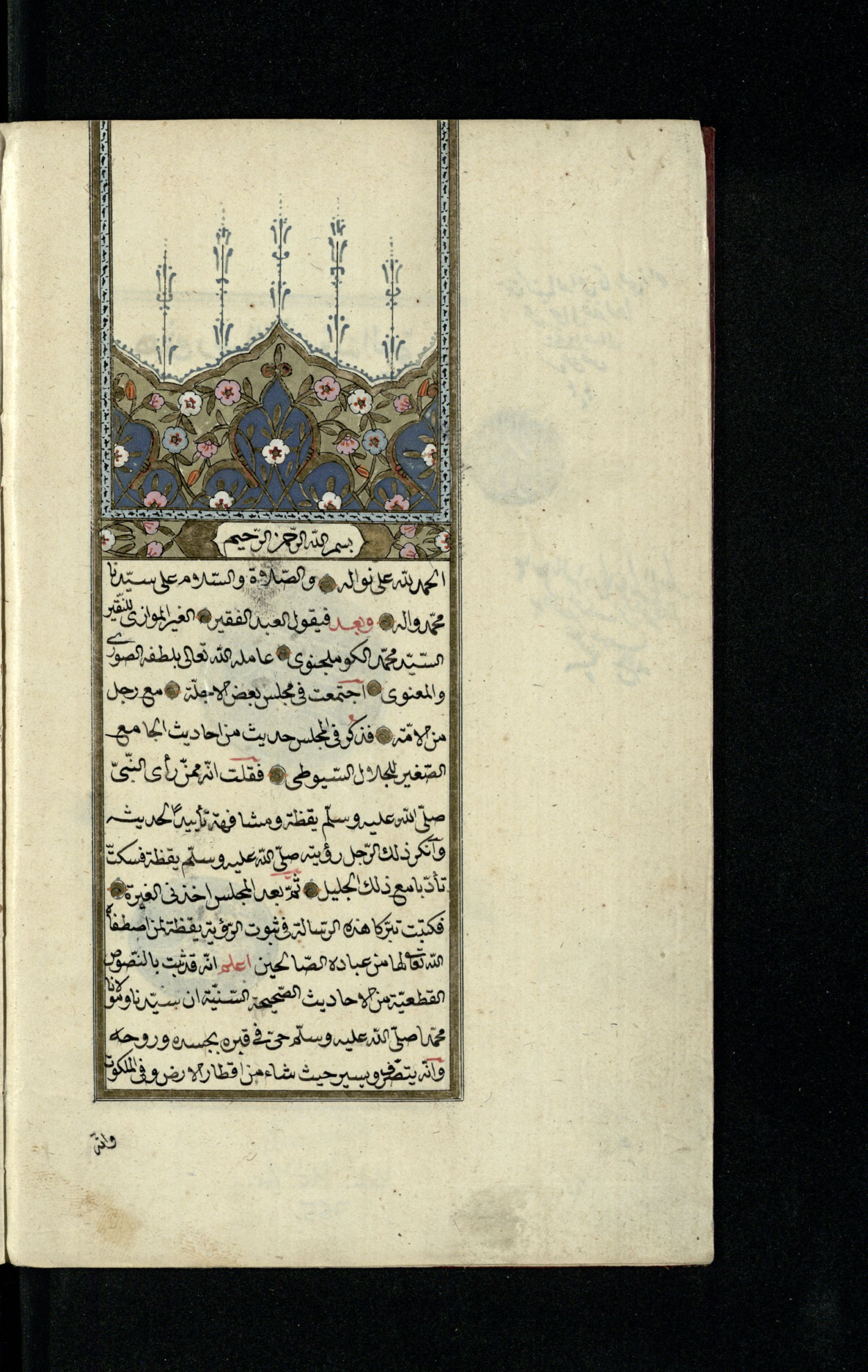
The subject for our Ottoman Turkish reading group is a fascinating but little—or, more accurately, not at all—known manuscript, <a href="https://archive.org/details/diaryofjourneyfr00shak/page/n11/mode/2up">Thomas Fisher Rare Book Library MSS 04044</a>. Finished in 1768, the manuscript lacks its opening pages, which might have been few or many, as it is a diary of the author’s journey to and from Mecca as part of the annual ḥajj, but picks up during his return trip. Whether he recorded the entire journey and experience of the ḥajj, or decided to begin writing only in Damascus, is unknown to us at the moment.</p>

<p>Regardless, this manuscript is an incredible treasure trove of details on early modern life and mentality, both as a description of eighteenth century Syria and as a window into a relatively middling Ottoman traveler. We do not know for certain what our traveler’s position or job was; he acts as an imam sporadically, and seems to have engaged in a bit of low-level trading, but otherwise his status is, so far, quite opaque. His handwriting is neat and clear given the likely circumstances of writing; his Ottoman Turkish prose is straightforward and usually clear, though at times his syntax is unusual or perhaps indicative of his having written while on the road. He does not seem to have been fluent in Arabic but had some capacity therein, sprinkling in short Arabic phrases and alternating Turkish in derivation words with Arabic ones. There are no long <em>izafet</em>s full of Persian words and phrases as might be expected from a more refined writer of the period, nor have we encountered more than a couple of lines of verse. Our author filled just about every square inch of his paper, writing right to the edges, generally maintaining straight lines but sometimes ending up with awkwardly shaped final lines due to slanting.</p>

<p>What did he write about? Just about everything! The manuscript opens with a veritable tour of holy places in and around Damascus, including some that per other similar sources Turkish speaking travelers usually did not patronize and about which they might well have not been aware. Our traveler however was comprehensive, visiting one site after another on the flanks of Jabal Qasiyun, leaving pious graffiti—which he notes and sometimes records the contents of—at various locations. During his stay in Damascus he recorded all manner of things, from the very quotidian such as what he had for dinner to the architectural details of the Umayyad Mosque, architecture being a recurring theme of his and a clear personal interest. Indeed his descriptions of things are very often almost identical with what we would expect from a modern tourist interested in historical sites, local cuisine, and beautiful natural scenery. He writes of the psychological pleasure of travel, of the experience of bedding down under the stars with his saddlebags as a pillow, and of getting a haircut. His record of everyday life and practice in Ottoman Syria is remarkably positive: at no point does he castigate locals for their lack of proper morals or adherence to Islamic norms, probably because he saw no such problems. He smokes and drinks coffee and writes requests to saints for their prayers; he acts as an imam for prayers, visits mosques, but also hangs out in the picnic grounds outside Damascus and stays up late into the night with his friends drinking coffee, smoking, and talking. Women appear with some regularity in his narrative, including notes about differences in dress and deportment, reported in a matter of fact manner without condemnation or concern.</p>

<p>There is a great deal more to be said about this traveler and his diary—including that we pretty strongly suspect based on internal clues that is indeed a proper diary, recorded at various points on his journey. Part of our goal in our reading and editing group is to in time make a public presentation of the edition that we create, with a full transcription, annotation, and interpretive essays and partial translations of different passages of especial interest. Our practice so far has been to use our automatic transcription model, generated by OpenITI over the course of our manuscript training data work, and then to divide up the text among participants for correction, followed by double-checking by another editor. During our Monday sessions we work through the text line by line, reading out loud and translating, often taking time to explore particular themes or to trace our traveler’s route on modern maps. In time we would like to produce a full digital edition, details of hosting, appearance, and so forth to be worked out based on what is available and feasible. In the meantime we would love to add a few more participants as we move towards our ultimate goal of a digital edition, just let us know and we’ll get you added!</p>]]></content><author><name>Jonathan Parkes Allen</name></author><summary type="html"><![CDATA[This fall and next spring we are offering two weekly manuscript reading and discussion groups, tackling two very different but equally interesting manuscripts. This post will cover the Ottoman Turkish text and reading group, while a subsequent post will cover the Persian one. Before we get into the details, note...]]></summary><media:thumbnail xmlns:media="http://search.yahoo.com/mrss/" url="/images/blogs/2025-10-27/From-Damascus-to-Istanbul-With-Our-Fall-Jonathan%20Parkes%20Allen/media/image1.png" /><media:content medium="image" url="/images/blogs/2025-10-27/From-Damascus-to-Istanbul-With-Our-Fall-Jonathan%20Parkes%20Allen/media/image1.png" xmlns:media="http://search.yahoo.com/mrss/" /></entry><entry><title type="html">Texts, Tools, and the Future of Islamicate Humanities: OpenITI Conversations</title><link href="/2024/09/13/Texts-Tools-and-the-Future-of-Islamica.html" rel="alternate" type="text/html" title="Texts, Tools, and the Future of Islamicate Humanities: OpenITI Conversations" /><published>2024-09-13T00:00:00+00:00</published><updated>2024-09-13T00:00:00+00:00</updated><id>/2024/09/13/Texts--Tools--and-the-Future-of-Islamica</id><content type="html" xml:base="/2024/09/13/Texts-Tools-and-the-Future-of-Islamica.html"><![CDATA[<p>We know that our colleagues across Islamicate humanities are working on a vast range of topics, incorporating innovative methods, tools, and theoretical approaches, and thinking about the implications of textual and other technologies on their subjects, research methods, and pedagogical practices. We all interact with texts in some form or another, especially when we define ‘text’ in an expansive manner, recognizing the textually-entangled nature of objects and practices and ideas that do not fall neatly into the usual categories. The omnipresence of digital environments, methods, and tools, including many that are quite novel, adds additional layers of interest and complexity to our uses and perceptions and generation of textuality.</p>

<p><a href="/images/blogs/2024-09-13/Texts--Tools--and-the-Future-of-IslamicaJonathan%20Parkes%20Allen/media/image1.jpeg"><img src="/images/blogs/2024-09-13/Texts--Tools--and-the-Future-of-IslamicaJonathan%20Parkes%20Allen/media/image1.jpeg" alt="" /></a></p>

<p class="figcaption">Generative AI, including prompt-generated images like the above, is approaching ubiquity online. Should we as scholars embrace it? Avoid it? Deploy tools and theories to understand its appeal and usages?</p>

<p>We at OpenITI would like to talk with other scholars working in fields within the Islamicate humanities about these sorts of topics, giving a platform for our colleagues to raise ideas, publicize their ongoing work, and just reflect out loud on topics and issues that are pertinent to all of us. Towards this end, we are inviting scholars of whatever affiliation, status, and specialization, to meet with us virtually for recorded conversations on a topic of your choosing, so long as it in some way intersects with questions of texts, of textuality, and/or digital tools, methods, and practices. We’re aiming to produce videos out of these conversations of approximately ten to fifteen minutes in length, to be uploaded to our YouTube channel and circulated via this blog and our social media presence</p>

<p>These conversations will also serve as an archive of scholarly practices, attitudes, research projects, and interests as they currently exist, informing both our ongoing work in OpenITI and as reference points for future analysis. We will incorporate some of our findings into our digital workflows survey article (for which we are still soliciting responses<a href="https://docs.google.com/forms/d/1R_uFvLhXQsJPxe1LUduuJNrhbxx14pfCaK00uEOHx10/edit?ts=66906127">, see the form here</a>)</p>

<p>To give you an idea of what we’re looking for, the following are some topics we’d love to explore in conversation with other scholars:</p>

<ul>
  <li>
    <p>Uses of generative AI in research, pedagogy, and everyday life: how do you</p>
  </li>
  <li>
    <p>Accessing and using digitized texts, print, manuscript, and born digital</p>
  </li>
  <li>
    <p>Where you see the future of Islamicate textuality studies going (and scholarship more generally), what you’re optimistic about, what you’re concerned about</p>
  </li>
  <li>
    <p>Digital communications—how scholars use (or don’t use!) social media, things like Zoom, email, and so forth</p>
  </li>
  <li>
    <p>Scholarship on manuscript history, the history of reading (in the pre-modern and modern past as well as the present), book history—whether there is an overt digital component or not</p>
  </li>
  <li>
    <p>Ways in which your encounters with and uses of texts (printed books, digital texts, manuscripts) have changed over the course of your scholarly career</p>
  </li>
  <li>
    <p>Ways in which texts and textuality—analog and digital, typographic and handwritten—relate to your ongoing research and interests</p>
  </li>
  <li>
    <p>The place of texts in your teaching, and how your approach to students and textuality may have changed over time</p>
  </li>
</ul>

<p>If you’re interested in holding a conversation on a topic like one of the above—or something else entirely that seems resonant with our goals—please get in touch so we can schedule a time to talk! Email me at <a href="mailto:jallen22@umd.edu">jallen22@umd.edu</a>, or Taimoor Shahid at <a href="mailto:tshahid@umd.edu">tshahid@umd.edu</a>. Thanks!</p>]]></content><author><name>Jonathan Parkes Allen</name></author><summary type="html"><![CDATA[We know that our colleagues across Islamicate humanities are working on a vast range of topics, incorporating innovative methods, tools, and theoretical approaches, and thinking about the implications of textual and other technologies on their subjects, research methods, and pedagogical practices. We all interact with texts in some form or...]]></summary><media:thumbnail xmlns:media="http://search.yahoo.com/mrss/" url="/images/blogs/2024-09-13/Texts--Tools--and-the-Future-of-IslamicaJonathan%20Parkes%20Allen/media/image1.jpeg" /><media:content medium="image" url="/images/blogs/2024-09-13/Texts--Tools--and-the-Future-of-IslamicaJonathan%20Parkes%20Allen/media/image1.jpeg" xmlns:media="http://search.yahoo.com/mrss/" /></entry><entry><title type="html">Introducing the Digital Islamicate Humanities Survey</title><link href="/2024/08/23/Introducing-the-Digital-Islamicate-Human.html" rel="alternate" type="text/html" title="Introducing the Digital Islamicate Humanities Survey" /><published>2024-08-23T00:00:00+00:00</published><updated>2024-08-23T00:00:00+00:00</updated><id>/2024/08/23/Introducing-the-Digital-Islamicate-Human</id><content type="html" xml:base="/2024/08/23/Introducing-the-Digital-Islamicate-Human.html"><![CDATA[<p>In today’s academic world, virtually every scholar in the humanities, Islamicate and otherwise, engages with digital tools and methods of some sort. Whether it is through search engines, electronic catalogs, digitized manuscripts, electronic word processors, email, or social media, the use of digital resources and digital tools has become integral to our scholarly work. Despite the ubiquity of the digital in our day-to-day work, many of us have never really reflected at any depth on our digital workflows and processes or the ways in which our digital habits interact with our scholarly work as a whole.</p>

<p><a href="/images/blogs/2024-08-23/Introducing-the-Digital-Islamicate-HumanJonathan%20Parkes%20Allen/media/image1.png"><img src="/images/blogs/2024-08-23/Introducing-the-Digital-Islamicate-HumanJonathan%20Parkes%20Allen/media/image1.png" alt="" /></a></p>

<p>We—Jonathan Parkes Allen and Taimoor Shahid—are interested in hearing from you about your experiences as an Islamicate digital humanist, which in this case entails anyone using digital resources and tools for any field of study broadly related to the Islamicate world, modern or pre-modern, in history, literary studies, anthropology, and so forth. Our goal is to compose an article that surveys the diverse digital workflows and practices of our colleagues, reflecting on common themes, struggles, desires, and strengths. This will provide insights into the current state of the field and practice of Islamicate digital humanities and guide our future work at OpenITI.</p>

<p>If you are interested in participating, please <a href="https://docs.google.com/forms/d/1R_uFvLhXQsJPxe1LUduuJNrhbxx14pfCaK00uEOHx10/edit?ts=66906127">fill out the linked survey administered through Google Forms</a>. It consists of three short sections: your personal and academic information; short questions with multiple choice or yes/no answers; additional open-ended questions with more opportunity to reflect in your own writing to whatever length you desire.</p>

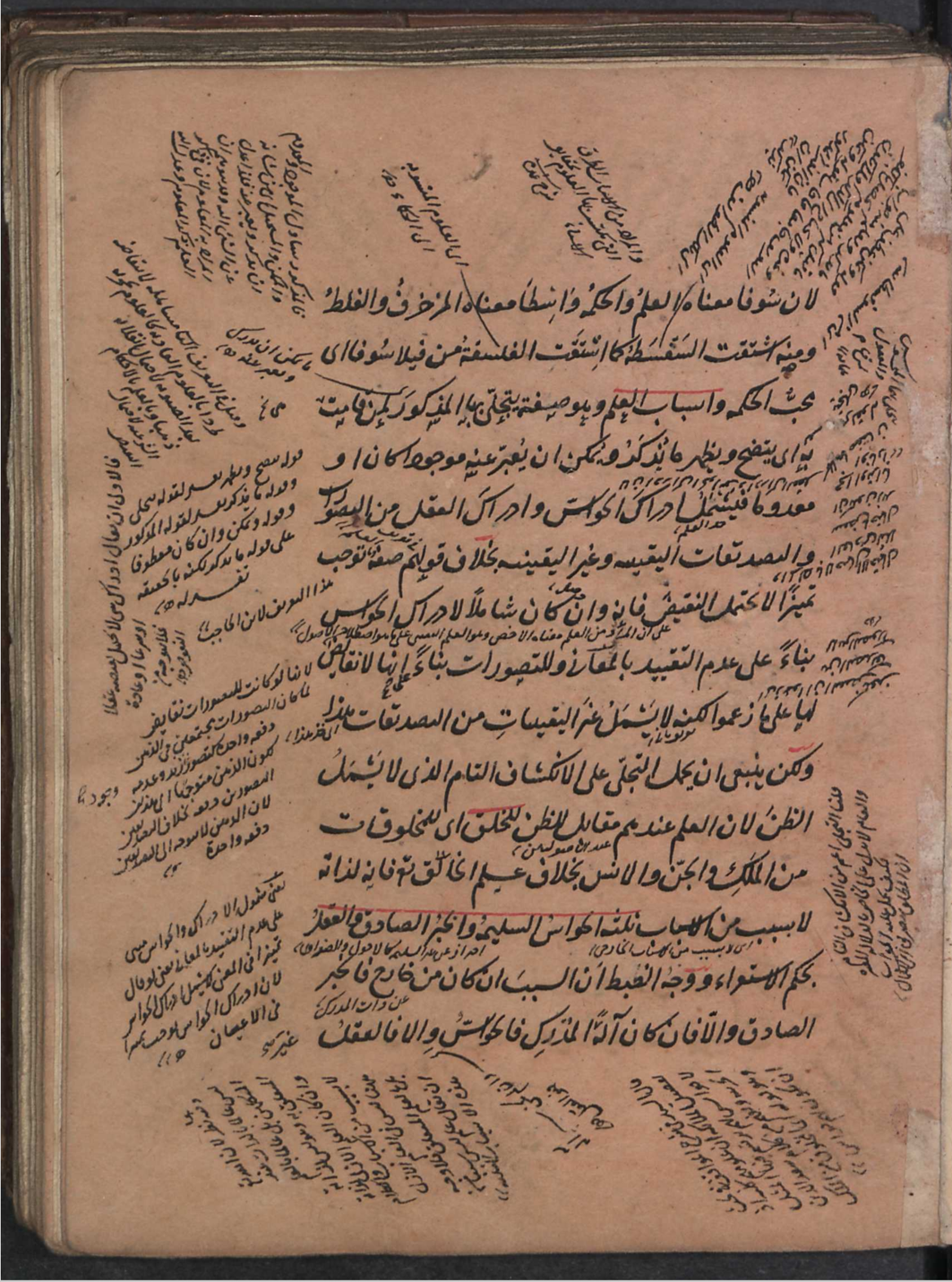
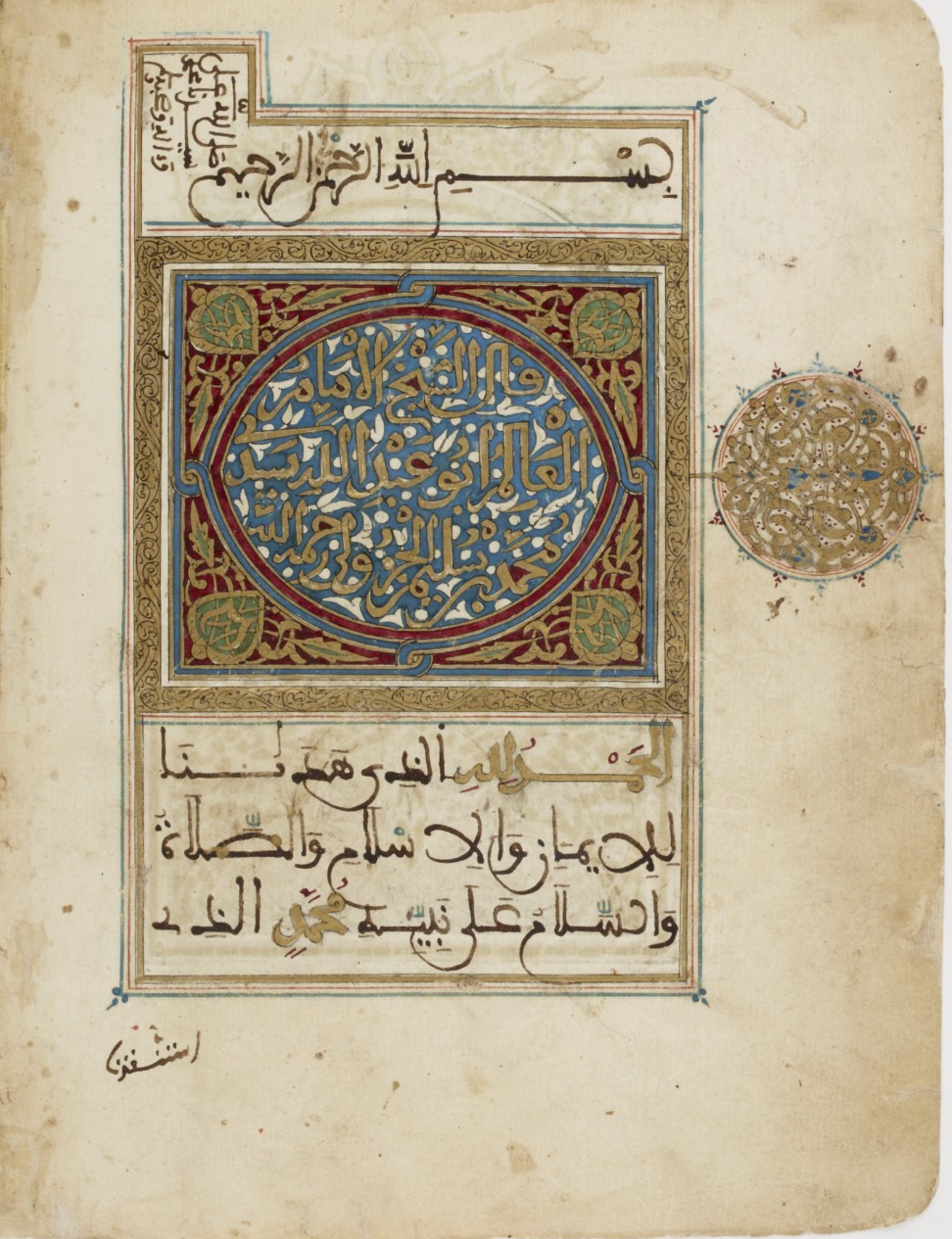
<p>We will lightly edit the responses for inclusion in the article and offer the option for anonymous submission, though we do encourage contributors to attach their names to their submissions, regardless of whether their digital workflows are cutting-edge or quotidian. We are not only looking for people who regard themselves as practitioners of the digital humanities, but anyone who makes use of any combination of digital resources and tools, from online text browsing to building your own programs from scratch. Thank you in advance for your participation!</p>]]></content><author><name>Jonathan Parkes Allen</name></author><summary type="html"><![CDATA[In today's academic world, virtually every scholar in the humanities, Islamicate and otherwise, engages with digital tools and methods of some sort. Whether it is through search engines, electronic catalogs, digitized manuscripts, electronic word processors, email, or social media, the use of digital resources and digital tools has become integral...]]></summary><media:thumbnail xmlns:media="http://search.yahoo.com/mrss/" url="/images/blogs/2024-08-23/Introducing-the-Digital-Islamicate-HumanJonathan%20Parkes%20Allen/media/image1.png" /><media:content medium="image" url="/images/blogs/2024-08-23/Introducing-the-Digital-Islamicate-HumanJonathan%20Parkes%20Allen/media/image1.png" xmlns:media="http://search.yahoo.com/mrss/" /></entry><entry><title type="html">An Introduction and Invitation to the Safīnat al-baḥr al-muḥīṭ Manuscript Reading Group</title><link href="/2024/08/20/An-Introduction-and-Invitation-to-the-Sa.html" rel="alternate" type="text/html" title="An Introduction and Invitation to the Safīnat al-baḥr al-muḥīṭ Manuscript Reading Group" /><published>2024-08-20T00:00:00+00:00</published><updated>2024-08-20T00:00:00+00:00</updated><id>/2024/08/20/An-Introduction-and-Invitation-to-the-Sa</id><content type="html" xml:base="/2024/08/20/An-Introduction-and-Invitation-to-the-Sa.html"><![CDATA[<p>After a break over the summer, we will be picking our OpenITI manuscript reading group back up for the fall academic semester, with a somewhat different iteration from previous semesters. In the past we have taken a somewhat ad hoc approach to our reading material, focusing on one manuscript for a few weeks at a time, an enjoyable approach that allowed us to cover many different genres, periods, scripts, and texts. However, this year we are taking a different tack, one that will be a supporting component of a larger project. Our focus this semester will be on reading through a single, albeit pretty monumental, manuscript, one of the volumes of a multi-volume “library between two (well, actually six in this case!) covers” compiled by the South Asian early modern scholar Muḥammad Khalīlallāh al-Shaṭṭārī and titled <em>Safīnat al-baḥr al-muḥīṭ</em>. Fully describing this work in the space of a blog would be impossible, indeed one of the goals of our larger project is to provide a thorough critical description of the <em>Safīnat</em> in all of its complexity and in terms of the origins and trajectories of the texts contained within it; the selection process for compilation; the internal logics and orders of texts, paratexts, visual and organization material that make up the work; the theory of readership that animates the work; and the later reception and use history of the volumes, which have today ended up far apart in different parts of the world.</p>

<p><a href="/images/blogs/2024-08-20/An-Introduction-and-Invitation-to-the-SaJonathan%20Parkes%20Allen/media/image1.jpeg"><img src="/images/blogs/2024-08-20/An-Introduction-and-Invitation-to-the-SaJonathan%20Parkes%20Allen/media/image1.jpeg" alt="" /></a></p>

<p>Before describing this larger project that we are in the early stages of launching, here’s what we’re envisioning for this fall’s reading group, one which anyone out there interested in Islamicate manuscript is welcome to join: while we cannot read the entirety of this text in one semester (and indeed finding ways within the DH toolkit to “read” the text at scale is part of our larger project’s ambit), we can take “soundings,” getting a feel for the contents of different sections, looking at how commentary, notations, and other paratextual elements went together with “main” texts (and whether we ought to even talk of main and marginal texts in all cases), and so forth. As we read we will try to work out what the experience of reading such texts in the early modern world might have been like—how a reader might have selected particular texts, read other texts in conjunction with one another, worked out relationships, genres, and so forth. Think of it as a kind of experimental or participatory archeology of the book, focusing not just on our encounter with the semantic content but also the codicological affordances, the structures and arrangements, and all of the paratextual guides and indicators al-Shaṭṭārī included.</p>

<p>We will start with the compiler’s introduction to the work, which describes his reason for writing and his de facto theory of readership, then select additional sections to read, transcribe, and, in some cases, translate into English (for a list of many, though not at all, texts contained within this volume <a href="https://www.qalamos.net/receive/DE1Book_manuscript_00002385">see the Qalamos entry</a>). The texts are in Persian and, to a lesser extent, Arabic, so readers of either or both languages are especially welcome—and if you are a learner (which we all are to some extent when this sort of material is considered) this will be a great opportunity to practice your Persian and/or Arabic, while also encountering a range of hands and script styles, many of which are represented within the work’s covers. We may at some points this semester and next read as supplementary material relevant secondary literature works, which will be posted in advance, alongside our weekly journey through the <em>Safīnat</em>.</p>

<p>Our sessions will be held via Zoom on Tuesday mornings from 10 am Eastern US time to 11:30 am or so, not going past 12 pm. If you would like to join, the best way would be to email me directly at <a href="mailto:jallen22@umd.edu">jallen22@umd.edu</a> and I will send you a Calendar invite with the Zoom link. We also have a Slack workspace that participants are encouraged to join, wherein weekly sessions will be outlined in advance in terms of sections to be read.</p>

<p><a href="/images/blogs/2024-08-20/An-Introduction-and-Invitation-to-the-SaJonathan%20Parkes%20Allen/media/image2.jpeg"><img src="/images/blogs/2024-08-20/An-Introduction-and-Invitation-to-the-SaJonathan%20Parkes%20Allen/media/image2.jpeg" alt="" /></a></p>

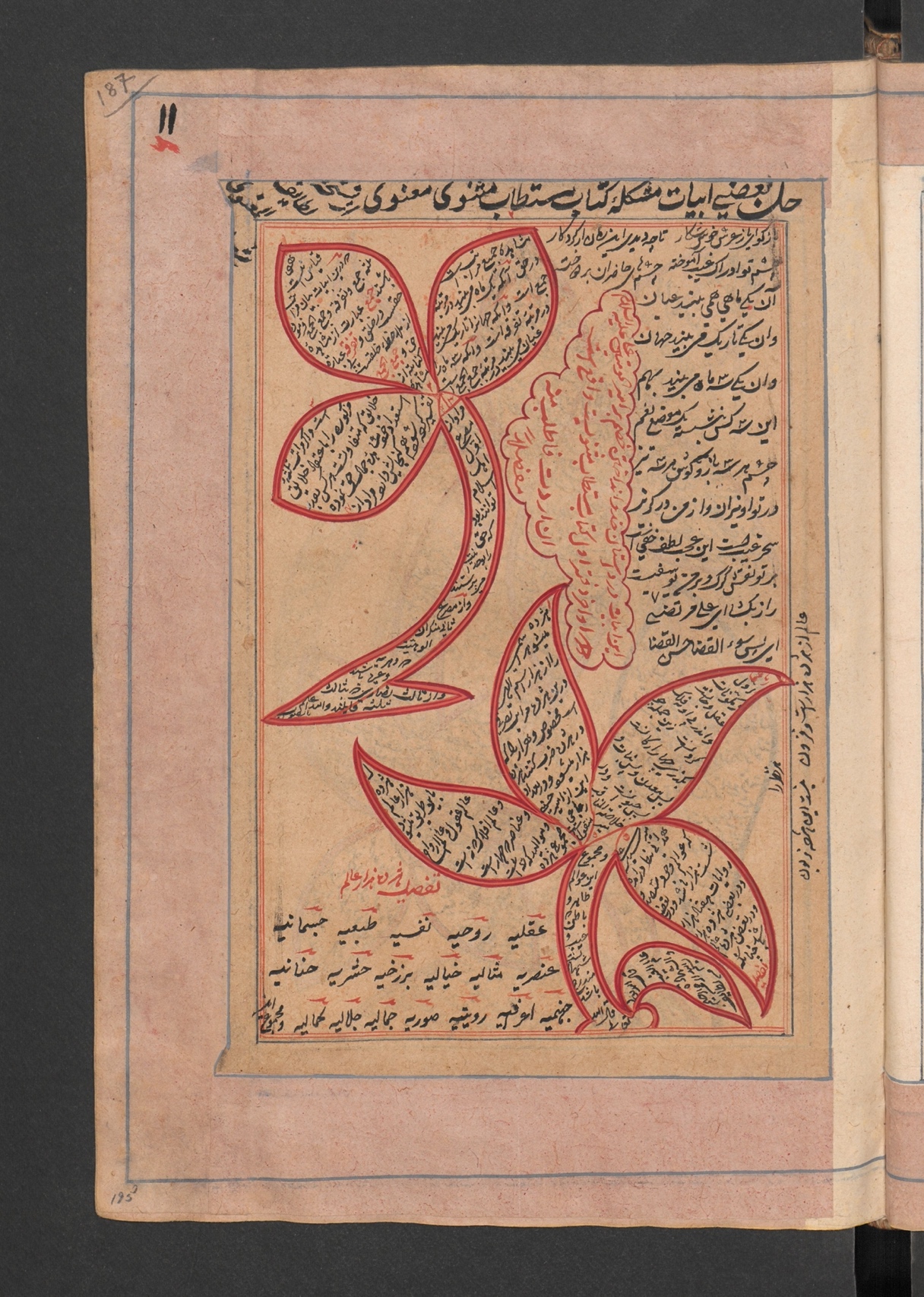
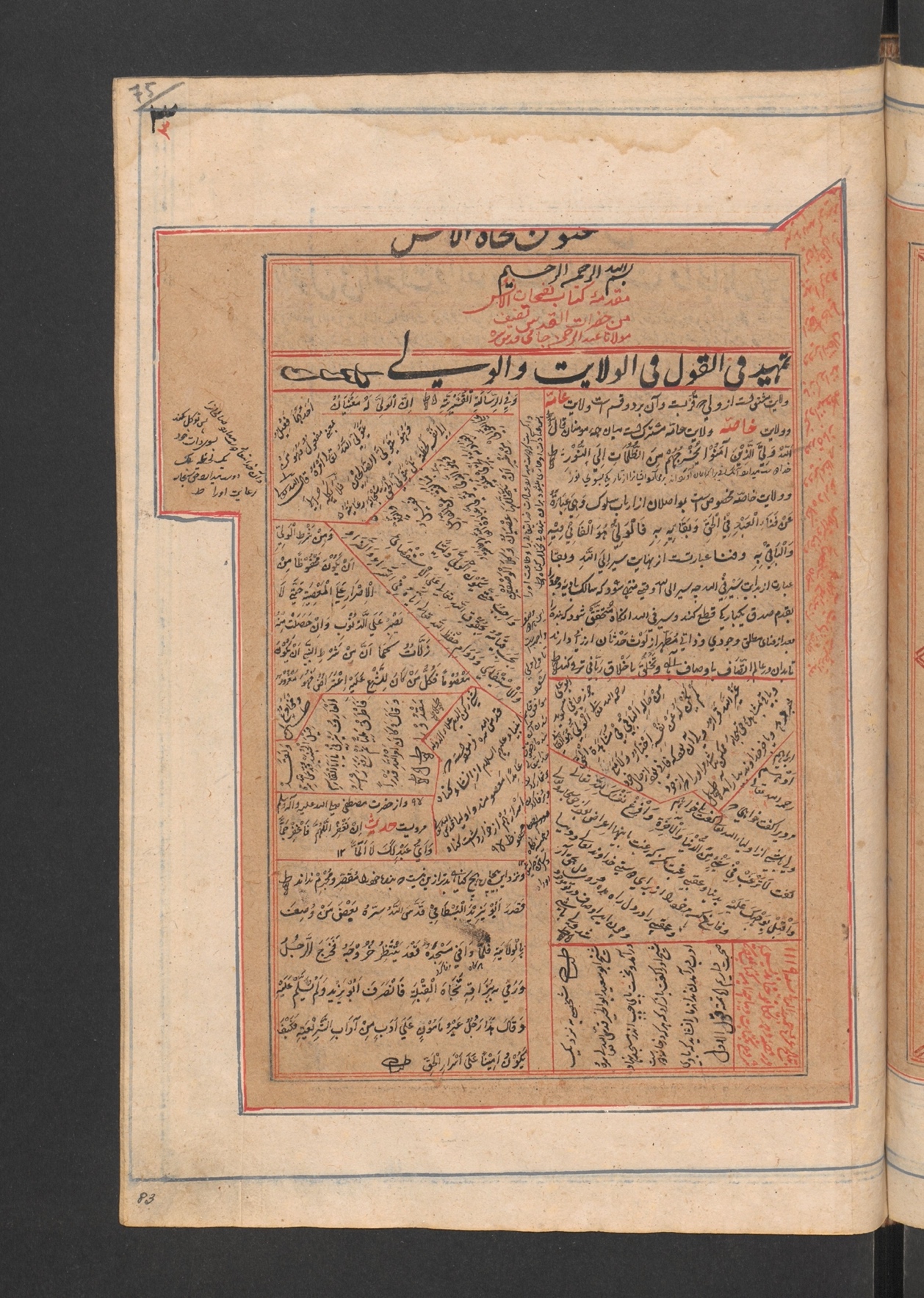
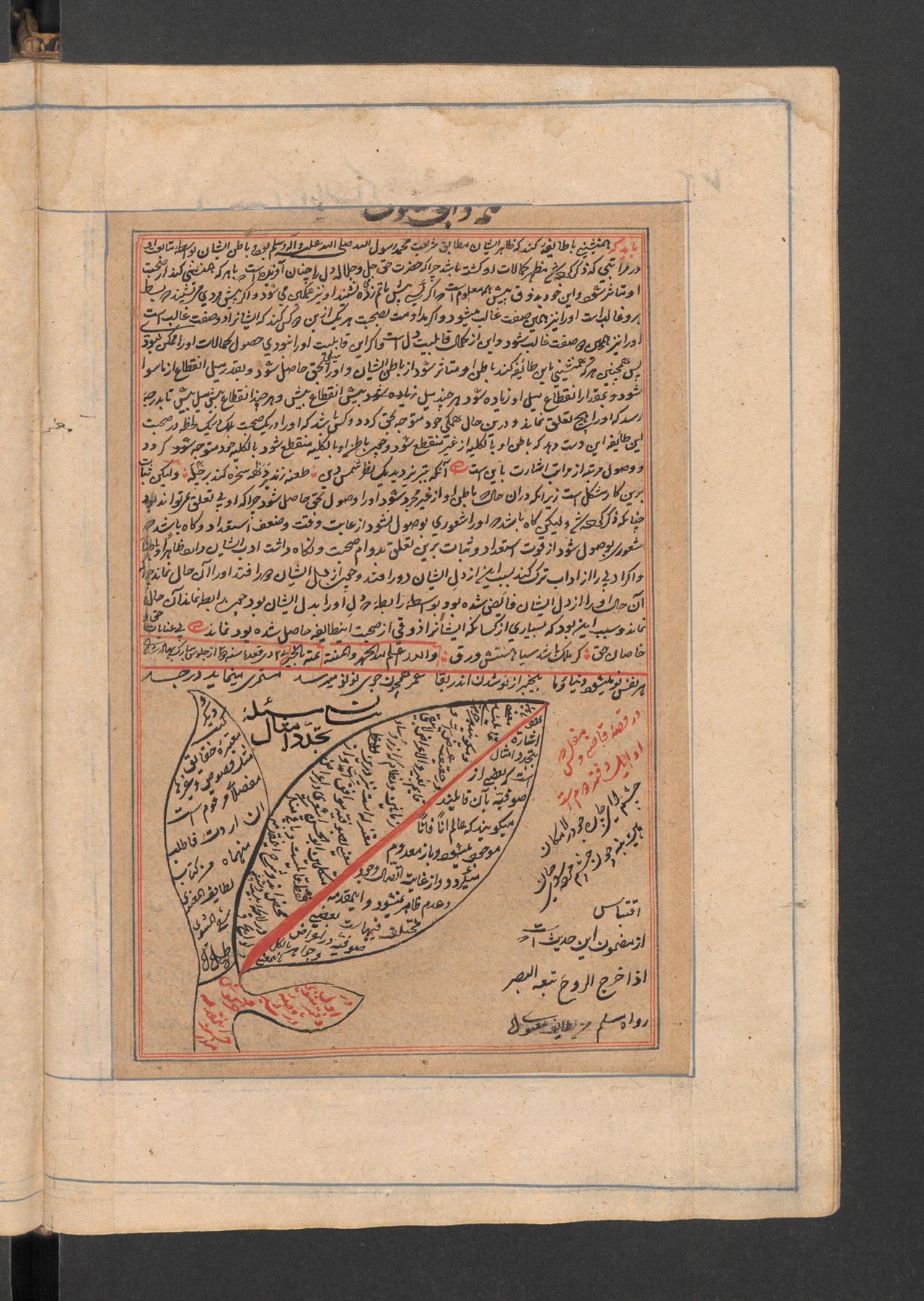
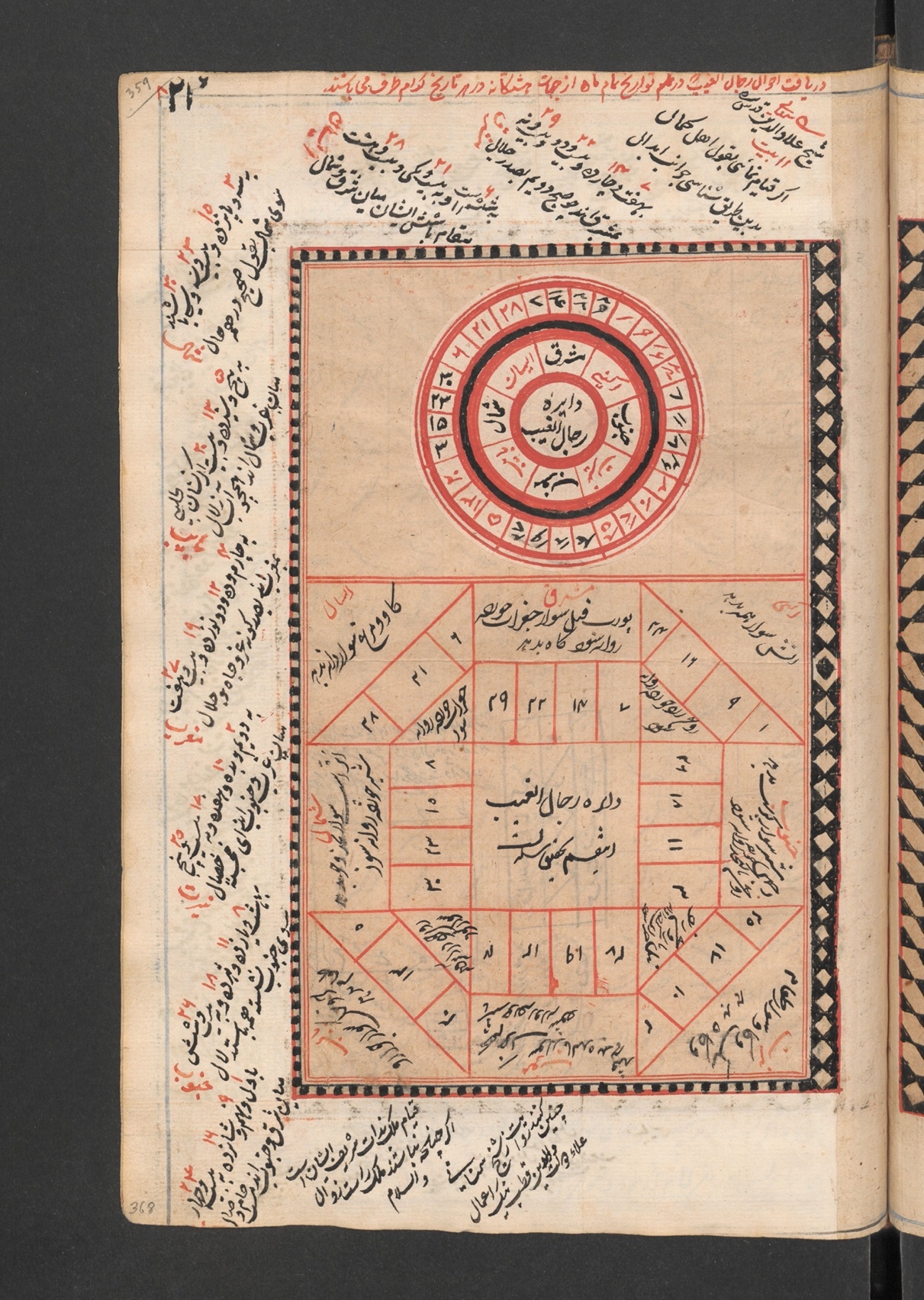
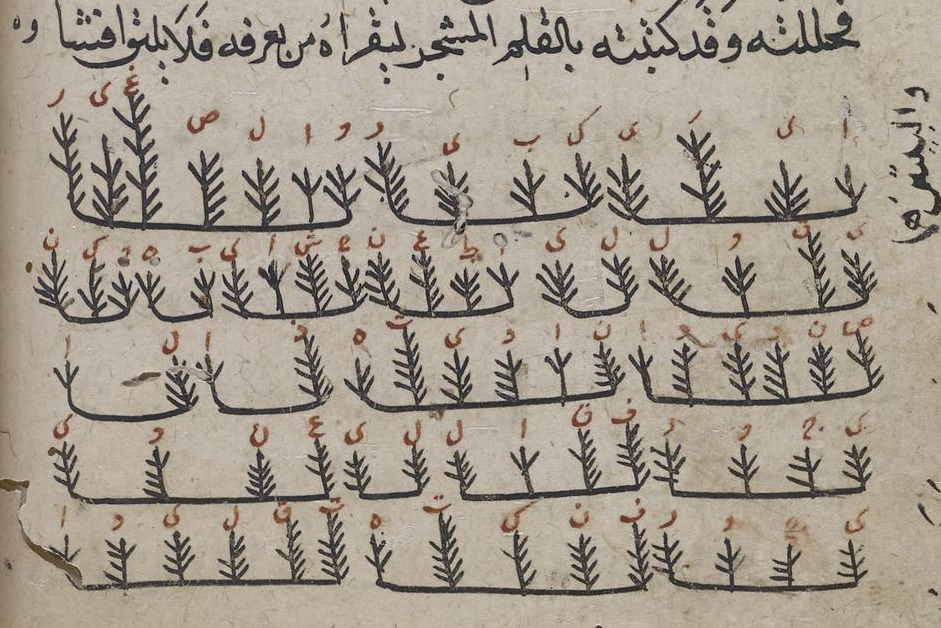
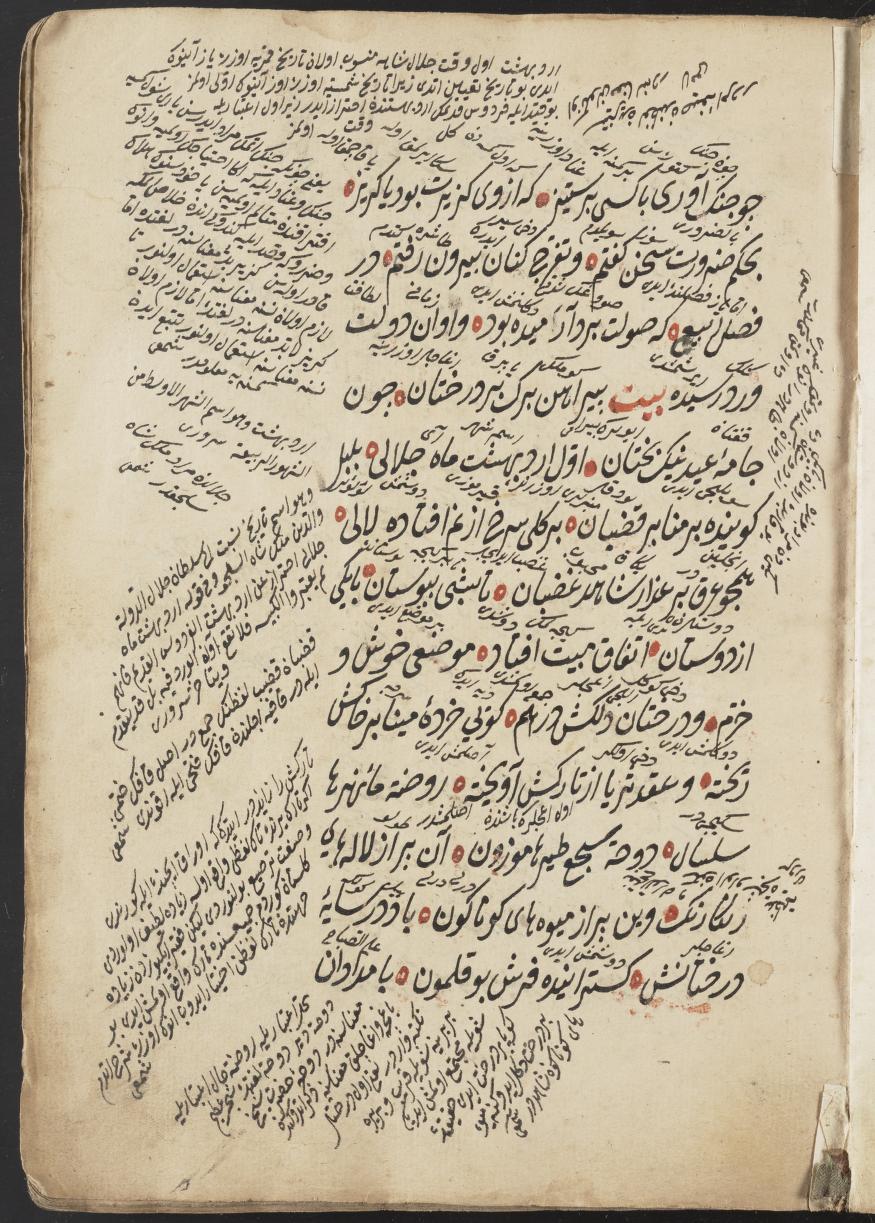
<p>Now, a little more on this manuscript and why we chose it as the focus of what will hopefully be a grant-supported multi-year project. First off, it is a spectacular object, each page carefully crafted for aesthetic impact as well as the conveyance of information (and perhaps more than simply information but other affects and emotional impacts as well). Along with the diversity of hands and calligraphic material, the reader is immediately struck by the many different shapes and arrangements into which blocks of texts have been carefully laid—this is not a case of successive generations of gloss-writers running low on room, but of our compiler (and his contributers, not everything is in his own hand) plotting out the location and shape of texts well in advance, towards ends that are not always intuitive to us and which will require research to untangle.</p>

<p><a href="/images/blogs/2024-08-20/An-Introduction-and-Invitation-to-the-SaJonathan%20Parkes%20Allen/media/image3.jpeg"><img src="/images/blogs/2024-08-20/An-Introduction-and-Invitation-to-the-SaJonathan%20Parkes%20Allen/media/image3.jpeg" alt="" /></a></p>

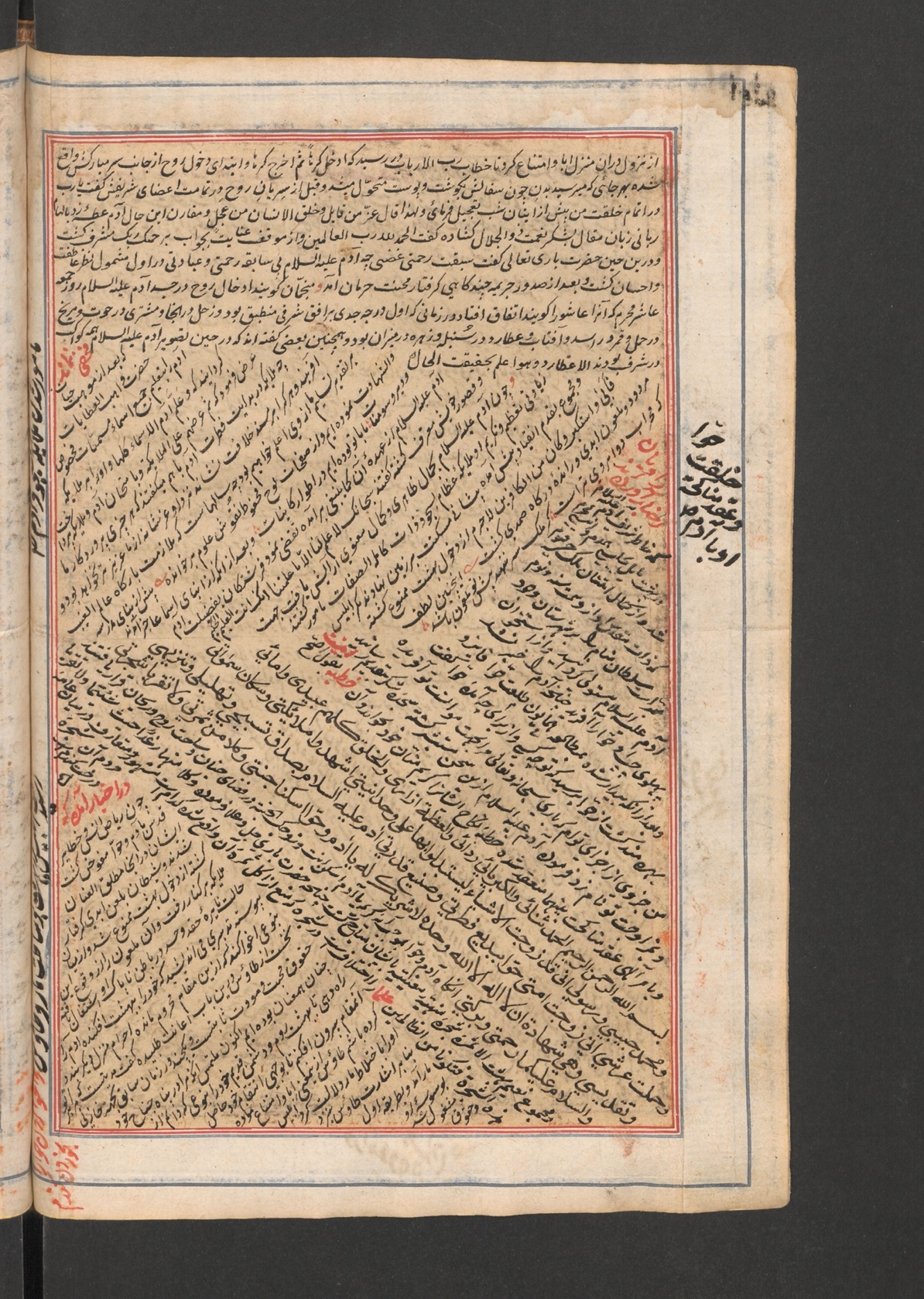
<p>One thing that is clear from both al-Shaṭṭārī’s introduction and from the texts we have examined thus far is that our compiler/author had a basically autonomous readership in mind—he did not simply compile this work for his own benefit (distinguishing it from <em>majmū’a</em>s that are more akin to a personal commonplace book) but intended it to be read by others, to be used as a sort of library of everything that one needed to know. Hence the seemingly rather peculiar spatial layouts we encounter are not excercises in cleverness or intended only for passing visual effect, but have some purpose in guiding and shaping the reader and conveying something that could not be transmitted otherwise. We thus have a potential opening into one part of the longer history of reading in the Islamicate world, from the medieval period in which, ideally at least, readers maintained an oral or aural connection with the author of a text, interacting with texts in an environment of shaykhly instruction conveyed in person, to the ultimate world of print in which the reader could pick and choose among books which he or she read as an effectively autonomous individual, the author’s intervention remaining confined to the pages of the book. The <em>Safīnat,</em> as befits its 18<sup>th</sup> century composition, seems to represent a transitional point in that historical trajectory, fitting with other trends and transformations taking place not only in South Asia but across the Islamicate world.</p>

<p><a href="/images/blogs/2024-08-20/An-Introduction-and-Invitation-to-the-SaJonathan%20Parkes%20Allen/media/image4.jpeg"><img src="/images/blogs/2024-08-20/An-Introduction-and-Invitation-to-the-SaJonathan%20Parkes%20Allen/media/image4.jpeg" alt="" /></a></p>

<p>At the same time, the <em>Safīnat</em> contains a trove of Persian and Arabic writings that stretches across the centuries, from compositions original to al-Shaṭṭārī himself all the way back to classical texts of literature, akhlāq, sufism, and so forth; many of the “ancient” texts however embedded within frameworks of commentary and annotation, while also representing textual traditions the contents of which might be quite different from other known exemplars. As such this work gives us a window into the textual universe of early modern South Asian Islam, and of early modern Islam more broadly—the texts that were being read, as well as the frames of reception and exegesis.</p>

<p>And because we are primarily interacting with this work in a digital environment, using tools and methods already existing while also considering new ways to explore a spatially complex and challenging work, the Safīnat will provide a testing ground for expanding the reach and scope of Islamicate digital humanities, or so we hope! In a way we are simply extending the genealogy of textual technology within which this manuscript stands, combining innovative approaches at the edge of our technological affordances with old texts and long-established modes of thought and analysis.</p>

<p><a href="/images/blogs/2024-08-20/An-Introduction-and-Invitation-to-the-SaJonathan%20Parkes%20Allen/media/image5.jpeg"><img src="/images/blogs/2024-08-20/An-Introduction-and-Invitation-to-the-SaJonathan%20Parkes%20Allen/media/image5.jpeg" alt="" /></a></p>]]></content><author><name>Jonathan Parkes Allen</name></author><summary type="html"><![CDATA[After a break over the summer, we will be picking our OpenITI manuscript reading group back up for the fall academic semester, with a somewhat different iteration from previous semesters. In the past we have taken a somewhat ad hoc approach to our reading material, focusing on one manuscript for...]]></summary><media:thumbnail xmlns:media="http://search.yahoo.com/mrss/" url="/images/blogs/2024-08-20/An-Introduction-and-Invitation-to-the-SaJonathan%20Parkes%20Allen/media/image1.jpeg" /><media:content medium="image" url="/images/blogs/2024-08-20/An-Introduction-and-Invitation-to-the-SaJonathan%20Parkes%20Allen/media/image1.jpeg" xmlns:media="http://search.yahoo.com/mrss/" /></entry><entry><title type="html">From Scroll to Scrolling: On Genre, Textual Technology, and Unexpected Transformations</title><link href="/2024/04/12/From-Scroll-to-Scrolling-On-Genre-Text.html" rel="alternate" type="text/html" title="From Scroll to Scrolling: On Genre, Textual Technology, and Unexpected Transformations" /><published>2024-04-12T00:00:00+00:00</published><updated>2024-04-12T00:00:00+00:00</updated><id>/2024/04/12/From-Scroll-to-Scrolling--On-Genre--Text</id><content type="html" xml:base="/2024/04/12/From-Scroll-to-Scrolling-On-Genre-Text.html"><![CDATA[<p>During a recent one of our Thursday manuscript reading group sessions we explored a curious work produced in 913/1507 somewhere in the Ottoman lands and now held by the <a href="https://www.digitale-sammlungen.de/en/view/bsb00040063?page=2,3">Bayerische Staatsbibliothek München, shelfmark Cod. turc. 41</a>. The catalog describes it as a ‘talisman,’ though as we will see this is not a fully sufficient description. The most obviously striking aspect of this manuscript is its format: instead of the codex typical of Arabic script book production, this is a scroll, made of many separate pages joined together (the seams are easily visible in the image below). Such a choice in format immediately signals to us that there is likely to be something special about this manuscript in terms of its content and likely use.</p>

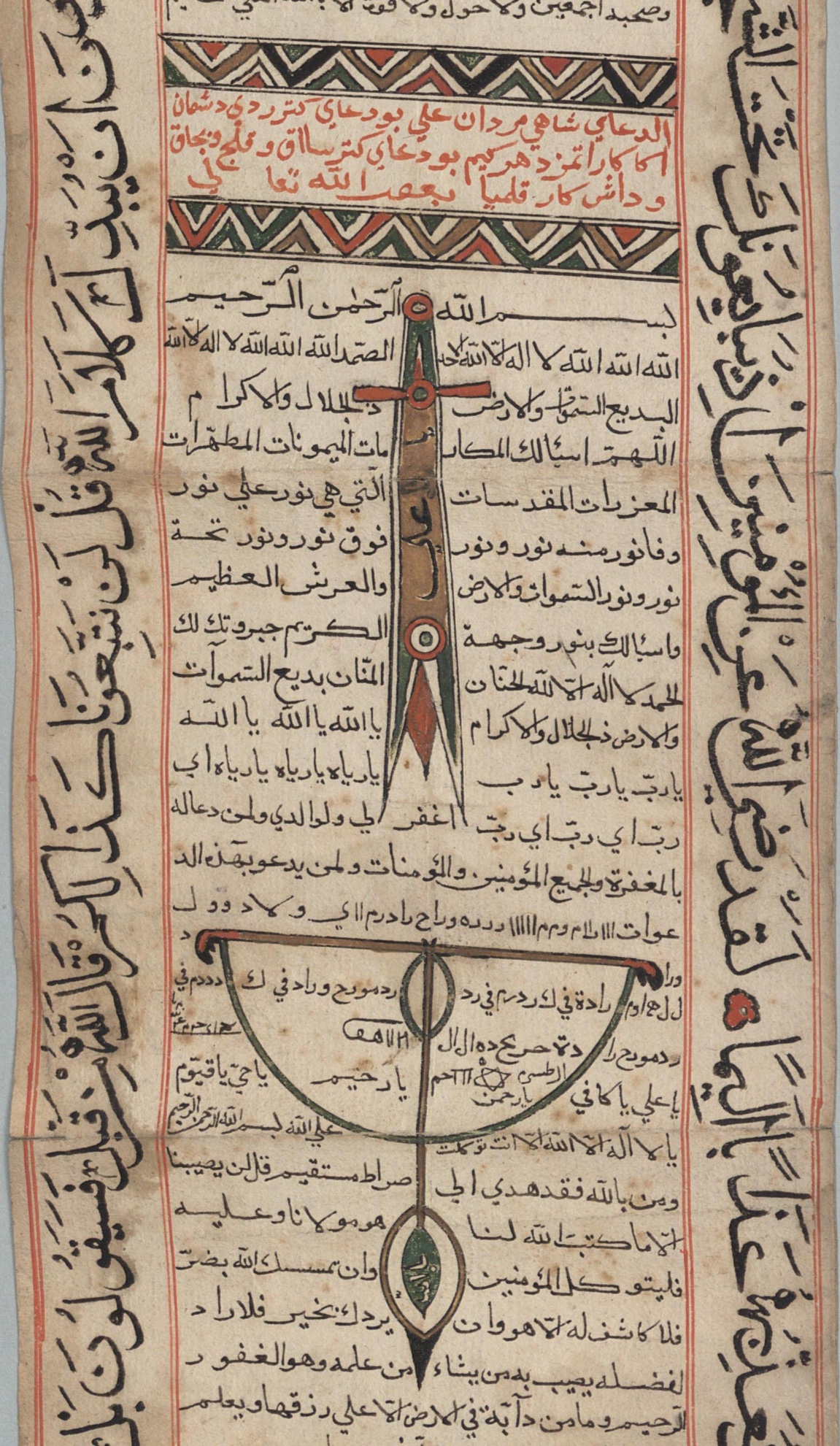
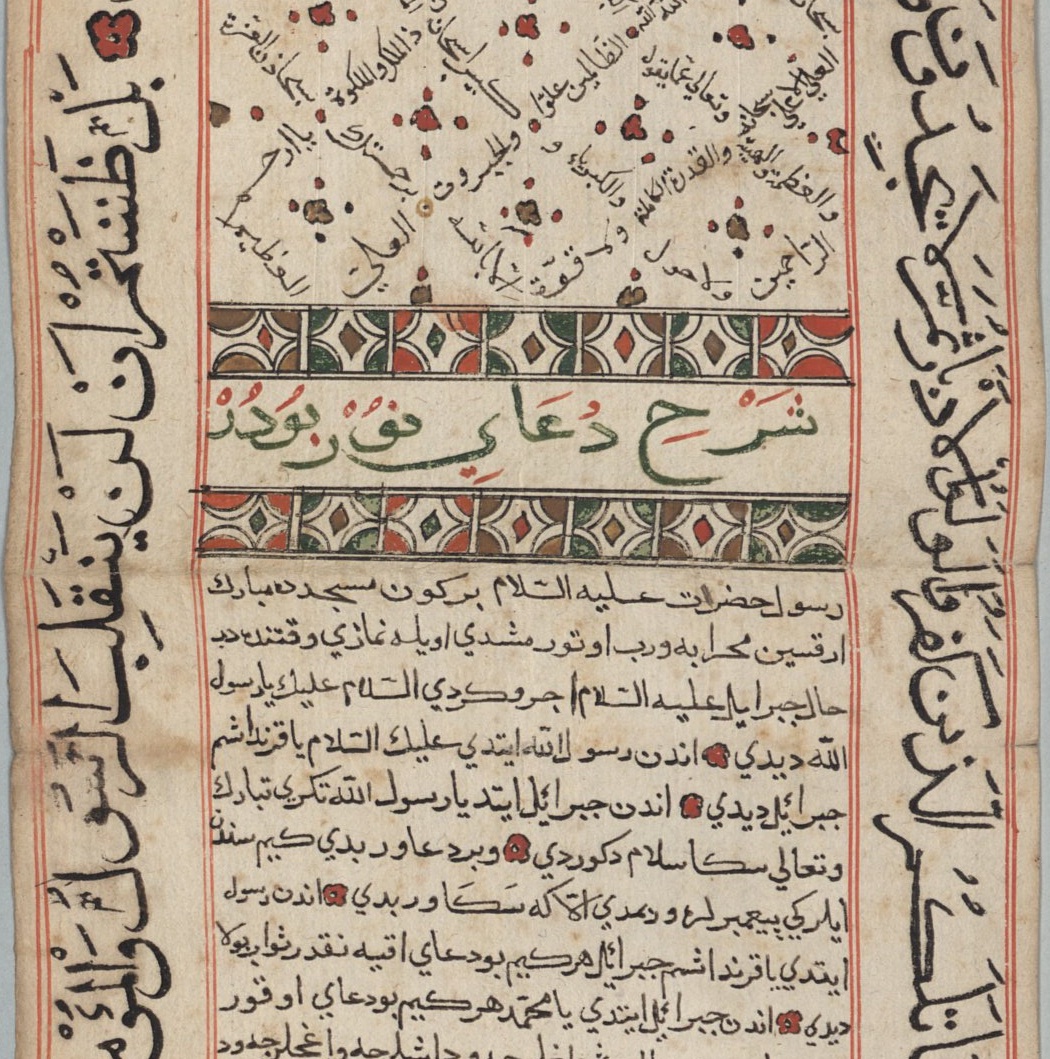
<p>Scroll formats appear intermittently in Arabic script manuscript cultures, ranging from pilgrimage certificates to genealogical/universal history visualizations (on which <a href="https://jonathanparkesallen.substack.com/p/charting-universal-histories">see a recent essay of mine elsewhere</a>) to so-called magical or talsimanic scrolls (such as <a href="https://asia-archive.si.edu/collections/new/acquisitions-2018/amulet-case-and-scroll/">this example with its protective case</a>). While it is beyond the scope of this short essay, there is a decent degree of continuity across script and religious traditions in these format choices—talismanic/magical scrolls are found in Ethiopian and Armenian contexts, scroll formats were adapted in the Latin West for charting universal histories, and so on—suggesting potential dynamics of interaction across boundaries as well as possible phenomenological reasons for resorting to the scroll over the codex for particular genres. Which raises the question of how best to classify our scroll. A quick perusal of the following section raises a few possibilities, just based on the visual aspects:</p>

<p><a href="/images/blogs/2024-04-12/From-Scroll-to-Scrolling--On-Genre--TextJonathan%20Parkes%20Allen/media/image1.jpg"><img src="/images/blogs/2024-04-12/From-Scroll-to-Scrolling--On-Genre--TextJonathan%20Parkes%20Allen/media/image1.jpg" alt="" /></a>
 </p>

<p>The eye is drawn immediately the imagery—most strikingly, <em>Dhū’l-faqār</em>, ‘Alī’s famous sword that features in many a devotional and prophylactic image context, joined here by a bow and arrow with a sprinkling of occult alphabet letters in its midst. And indeed as the Ottoman Turkish caption to the <em>dū’a’</em> that follows informs us, this particular prayer is effective against all manner of weaponry wielded by one’s enemies. So far we are very much in the territory of the talisman and amulet, in which text and image, substrate and medium, combine into a device believed by its users to be protective, activated as much by physical presence as by active reading or recitation. The calligraphic border, consisting of selections from the Qur’ān, suggests a similar function, the material presence of the text more important than its activation by a human reader.</p>

<p>However, things are a bit more complicated with this particular scroll: if we move up the text to another portion (and unfortunately the beginning is now missing, so if there were instructions for use they are now gone), we find more Arabic <em>dū’a’</em>s, along with Ottoman Turkish <em>şerḥ</em> for each, as here:</p>

<p><a href="/images/blogs/2024-04-12/From-Scroll-to-Scrolling--On-Genre--TextJonathan%20Parkes%20Allen/media/excerpt.jpg"><img src="/images/blogs/2024-04-12/From-Scroll-to-Scrolling--On-Genre--TextJonathan%20Parkes%20Allen/media/excerpt.jpg" alt="" /></a></p>

<p>The <em>şerḥ</em> here provides an origin story for the prayer as well as an explication of its benefits (and not, as the term <em>şerḥ</em> might otherwise suggest, a lemma by lemma interpretation); we might think of it as a kind of user’s manual for the <em>dū’a’</em> itself. What is especially interesting here is that it quite clearly seems meant to have been read by someone: the text is in Ottoman Turkish, so close to the vernacular of likely users, and is written in a clear, if miniscule, <em>naskh</em> hand with internal ‘punctuation’ to facilitate understanding. What this suggests to me is that we cannot think of this manuscript as having only been valued and used for its materiality, but also more as a text qua text, something to be actively read and recited, both for meaning—the explanation in the vernacular—and for its perceived power, even if the reader did not fully or at all understand the semantic meaning of the Arabic texts therein. If such an interpretation is correct, we can imagine a reader quite literally scrolling through these texts in order to read them. Perhaps this scroll would have also been displayed, hung on a wall, while it could have also been carried, rolled up, on someone’s person (it is 13 cm in width, so quite portable, but also fairly legible). There are signs of use, most notably the fact that the first section is now missing, with evidence of wear and tear (and perhaps also deliberate excision at some point) plainly visible.</p>

<p>As for the origin of the texts themselves, we did a brief search online to try and ascertain the origin of the text of the first <em>dū’ā</em>; we discovered, unsurprisingly, that no exact matches were to be found, though we did find other instances of devotional literature with elements—phrases of some length, close enough and long enough in duration to indicate some common source and not simply convergent textual evolution—common to our manuscript. Such a situation is to be expected: devotional literature (or however we want to most capaciously classify these sorts of texts) is a notably ‘promiscuous’ genre, subject to a great deal of remixing and matching, lines and chunks of text often easily transposable from one place to another. What struck us, though, was thinking about the medium of modern devotional literature (which also no doubt continues to serve a talismanic or otherwise protective function—there are no generic bright lines here): so much of this sort of material today is accessed via social media apps, in particular Facebook, and very often using mobile phones. Which means that the users of the descendants of our early modern scroll’s <em>dū’a’</em>s are… scrolling through the same kind of material, accessed on a compact and portable device, albeit one that can provide access to far more texts than a single manuscript scroll.</p>

<p>_________________</p>

<p>We always run the risk of attributing too much to the obvious instantiations of technology and ignoring other technological levels that might also be present, or the social, cultural, and other aspects that might govern the development and particular use-cases of technologies we would otherwise perceive to be basically ‘autonomous.’ As the anthropologist Pierre Lemonnier puts it, ‘social logics unrelated to technology may weigh heavily on the evolution of technological systems,’ leading to results that we would not predict based on the known trajectories and affordances of the technologies themselves. Our devotional-exegetical-protective scroll made use of an ‘obsolete’ form of textual conveyance, one long supplanted by the codex as the ordinary mode of textual production. However, the particular social logic of these texts, in which their material form was somehow linked to their protective potency (via, generally speaking, the need for portability) ensured the ‘survival’ of the scroll in such cases.</p>

<p>In the case of similar literature currently being composed, dissimulated, and used via platforms like Facebook and devices like smartphones, the obvious layers of technology are the novel ones: social media and handheld computing devices, the rough analogues of pre-digital social networks and small-format text containers (including scrolls!). The actual evolution of social media in all its diversity has been shaped—probably more heavily than we tend to assume—by pre-existing communities of use who have made use of and further pushed the boundaries of the digital affordances these technologies permit. The makers of Facebook and of smartphones did not set out to create platforms for d<em>ū’a’s</em> to be readily available to Muslims around the world, or to facilitate dhikr recitation and participation. Instead, existing communities (and newly emergent ones oriented around particular texts on particular platforms) have explored new uses and configurations of those technologies, developing their own devotional techniques and communities of response in the process.</p>

<p>It is striking that in our particular case the tactile experience of a devotional text has remained remarkably stable across the transition from devotional scroll to devotional (use of) social media apps: the user of Cod. turc. 41 would have literally ‘scrolled’ down the text in order to read the commentaries or recite or copy out the prayers, even as it might have remained most of the time rolled up, in a pocket or in a home, its intrinsic virtues and prophylactic power radiating with or without active reading or use (though as the commentaries make clear, actually reading/reciting these prayers/litanies was crucial to their full activation). Likewise, a contemporary user of online <em>dū’ā</em>s and <em>awrād</em> most likely scrolls up and down a screen, probably via an app, reading or reciting some of the very same material, centuries and centuries later.</p>

<p>There are also likely differences. If the scroll format helped to convey the materially embedded protective power of these texts, regardless of deliberate human activation, it is not obvious to me whether a digital <em>dū’a’</em> or other textual or image-based device acts in the same way. Do contemporary Muslim believers understand devotional, sacred, prophylactically powerful texts as having latent or active power when ‘stored’ on a smartphone or a computer? That I do not know, though I suspect that there are different responses, and that in general the mediation of digital technology does shape our reaction to them rather differently. As an Orthodox Christian, I have my own corpus of sacred texts and things that demarcate much of my everyday space: icons on the wall, Scripture on the bookshelf next to the icon corner, candles, crosses, and so forth, right down less obvious things like blessed flowers or willow branches from Palm Sunday. All of these are special things, even if that sense of specialness is somewhat inchoate at the edges and open to interpretation (what do you do with icons from a church bulletin, for instance?). But in general, in my own practice at least, they are accorded respect and have a sacred charge about them, regardless of active use or even visibility. But the same thing is not really true for the analogous ‘objects’ stored on my computer: icons and sacred texts do not seem to have the same valence, though whether that is a basically incoherent attitude relative to material objects ‘out in the world’ or not is a good question. Can a digitized copy of God’s most beautiful Names convey <em>baraka</em> when stored as a PDF or a JPEG? Does it make sense to venerate an icon on a computer screen? No doubt usage varies, but in general my sense is that the ‘rules’ are rather different in these cases; the nature of the materiality matters.</p>

<p>As we have often had occasion to remark on this blog, key to interpreting technological frames is teasing out the material and social and other types of affordances of a given ‘device’ or medium. If the Facebook <em>dū’a’</em> would seem to be lacking when it comes to the specifically material ‘charge’ and presence of the physical scroll, social media mediated devotional texts (and ‘text’ here should be interpreted as capaciously as possible, with video, audio, and still images figuring in to the equation in this context) excel when it comes to audience feedback-based participation. A social media posted prayer or litany provides a means to express one’s approval immediately <em>in a public manner</em> (hit the like/share/subscribe button!), to ‘copy’ and ‘transmit’ the text either through direct sharing or rapid re-use in some other fashion (copy and paste, rework, etc), and to publicly ‘annotate’ or amplify the original text via the comments section (unless they’ve been disabled, but in my experience this is rarely the case for this sort of material). Again, long-existing ‘technologies’ of engagement often end up being replicated using the affordances of the digital world, of social media specifically; the pious exclamations of a communal <em>dhikr</em> or <em>awrād</em> session are typed out instead of spoken (though of course they might be spoken as well, just not in a publicly legible manner). And, as our talismanic but not just talismanic scroll suggests, even seemingly quite restricted forms of textuality can still surprise us with their actual content and the ways people found to make use of their latent affordances and potential social and cultural uses.</p>]]></content><author><name>Jonathan Parkes Allen</name></author><summary type="html"><![CDATA[During a recent one of our Thursday manuscript reading group sessions we explored a curious work produced in 913/1507 somewhere in the Ottoman lands and now held by the [Bayerische Staatsbibliothek München, shelfmark Cod. turc. 41](https://www.digitale-sammlungen.de/en/view/bsb00040063?page=2,3). The catalog describes it as a 'talisman,' though as we will see this is...]]></summary><media:thumbnail xmlns:media="http://search.yahoo.com/mrss/" url="/images/blogs/2024-04-12/From-Scroll-to-Scrolling--On-Genre--TextJonathan%20Parkes%20Allen/media/image1.png" /><media:content medium="image" url="/images/blogs/2024-04-12/From-Scroll-to-Scrolling--On-Genre--TextJonathan%20Parkes%20Allen/media/image1.png" xmlns:media="http://search.yahoo.com/mrss/" /></entry><entry><title type="html">Hunting for Unusual Characters in Arabic Script Manuscripts</title><link href="/2024/02/27/Hunting-for-Unusual-Characters-in-Arabic.html" rel="alternate" type="text/html" title="Hunting for Unusual Characters in Arabic Script Manuscripts" /><published>2024-02-27T00:00:00+00:00</published><updated>2024-02-27T00:00:00+00:00</updated><id>/2024/02/27/Hunting-for-Unusual-Characters-in-Arabic</id><content type="html" xml:base="/2024/02/27/Hunting-for-Unusual-Characters-in-Arabic.html"><![CDATA[<p>One of the most potent affordances of manuscript textual production, as opposed to typographic or digital print, is the simple fact that handwriting permits a lot more variation and even downright weirdness in what ends up on the page. To be sure, speaking <em>generally</em> manuscript production tended to take place within certain socio-cultural limits or norms, scribes following established scripts, layout conventions, and various other elements of convention, all of which are fairly crucial for making one’s written product legible to others. However, even within those broadly acceptable parameters there was, and is to some extent still, a lot of variety in terms of what appeared on the page and what was incorporated into the writing itself. There is no one unitary Arabic script manuscript tradition, but instead many converging and interrelated but distinctive traditions. And to be sure at times the people who made and interacted with manuscripts took decidedly idiosyncratic routes that cannot be explained by reference to existing traditions of practice.</p>

<p>The resulting variety of semantic, and what we might call semi-semantic, signs and marks is a big part of what makes the manuscript tradition so interesting and exciting to explore; but when we set out to transcribe those manuscripts, “translating” them into a typographic or digital environment, we begin to encounter challenges, among them the question of what to do with characters that do not have Unicode representation, and which may be de facto unique, or so infrequent that it would make little sense to go through the process of generating exact digital representation. As we at OpenITI have begun to seriously work through these issues, we have realized that just having a better view of the issue at hand is important—just how much character diversity are we talking about? How do we distinguish what counts as a “character” and other elements incorporated into manuscripts? What ultimately do we need to represent and how?</p>

<p>So, in order to better get a handle on just what we’re up against as it were and to better illuminate the diversity—and sometimes downright weirdness—of the Arabic script manuscript tradition, we’d like to ask you, dear reader, to share examples from your own forays into the manuscript tradition, either via email for us to catalog and to share, or post them on Twitter and tag us (@openiti).</p>

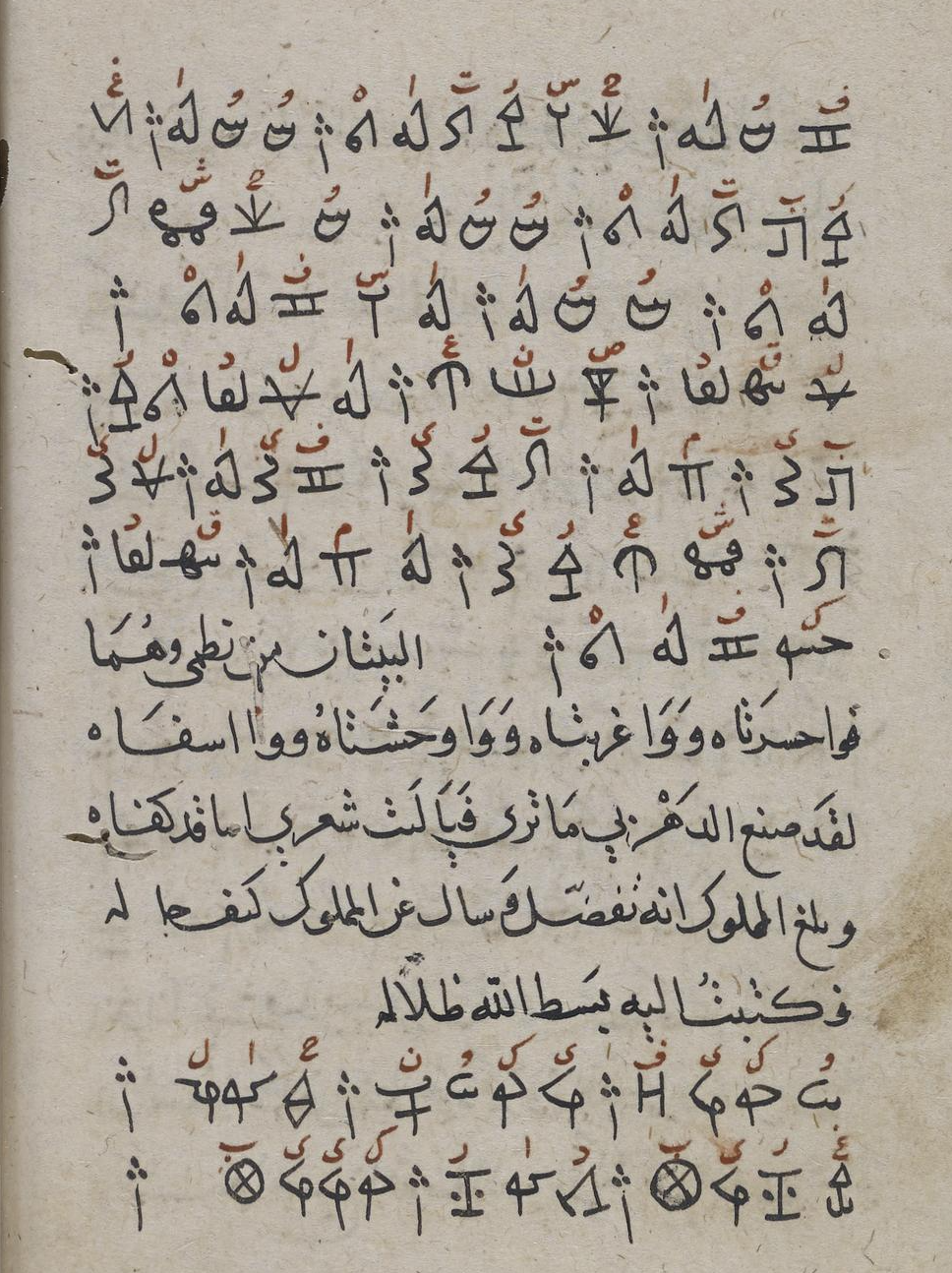
<p>To give you an idea of what we’re talking about and what we’re looking for, here are a few examples that I plucked from a folder of manuscript sample images—not precisely a random selection but pretty close to it. First, one of the more common and intractable sorts of characters that populate many an Islamicate manuscript (and beyond the confines of the tradition—these characters have a very long genealogy that pre-dates Islam and Arabic script both and would develop globally, well into the present) are the letters of “occult” or “magical” alphabets, such as in the following early modern Ottoman example:</p>

<p><a href="/images/blogs/2024-02-27/Hunting-for-Unusual-Characters-in-ArabicJonathan%20Parkes%20Allen/media/image1.png"><img src="/images/blogs/2024-02-27/Hunting-for-Unusual-Characters-in-ArabicJonathan%20Parkes%20Allen/media/image1.png" alt="" /></a></p>

<p>These sorts of characters come in seemingly all shapes and sizes, usually without the clarifying interlinear:</p>

<p><a href="/images/blogs/2024-02-27/Hunting-for-Unusual-Characters-in-ArabicJonathan%20Parkes%20Allen/media/image2.png"><img src="/images/blogs/2024-02-27/Hunting-for-Unusual-Characters-in-ArabicJonathan%20Parkes%20Allen/media/image2.png" alt="" /></a></p>

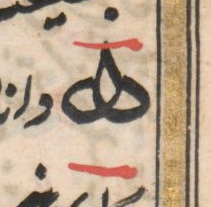
<p>Also frequently encountered across the tradition are marks—to use the most neutral term for what can be quite polyvalent characters—used to indicate things like punctuation, section divisions, and so on (and sometimes, as in the following instances, the exact purpose or purposes are not super clear):</p>

<p><a href="/images/blogs/2024-02-27/Hunting-for-Unusual-Characters-in-ArabicJonathan%20Parkes%20Allen/media/image3.png"><img src="/images/blogs/2024-02-27/Hunting-for-Unusual-Characters-in-ArabicJonathan%20Parkes%20Allen/media/image3.png" alt="" /></a></p>

<p><a href="/images/blogs/2024-02-27/Hunting-for-Unusual-Characters-in-ArabicJonathan%20Parkes%20Allen/media/image4.png"><img src="/images/blogs/2024-02-27/Hunting-for-Unusual-Characters-in-ArabicJonathan%20Parkes%20Allen/media/image4.png" alt="" /></a></p>

<p><a href="/images/blogs/2024-02-27/Hunting-for-Unusual-Characters-in-ArabicJonathan%20Parkes%20Allen/media/image5.png"><img src="/images/blogs/2024-02-27/Hunting-for-Unusual-Characters-in-ArabicJonathan%20Parkes%20Allen/media/image5.png" alt="" /></a></p>

<p>Other things to be on the lookout for: non-standard uses of dots, particularly the various combinations of stacking for adjacent dots, as here:</p>

<p><a href="/images/blogs/2024-02-27/Hunting-for-Unusual-Characters-in-ArabicJonathan%20Parkes%20Allen/media/image6.png"><img src="/images/blogs/2024-02-27/Hunting-for-Unusual-Characters-in-ArabicJonathan%20Parkes%20Allen/media/image6.png" alt="" /></a></p>

<p>Or the use of unusual or non-standard orthographic devices:</p>

<p><a href="/images/blogs/2024-02-27/Hunting-for-Unusual-Characters-in-ArabicJonathan%20Parkes%20Allen/media/image7.png"><img src="/images/blogs/2024-02-27/Hunting-for-Unusual-Characters-in-ArabicJonathan%20Parkes%20Allen/media/image7.png" alt="" /></a></p>

<p>Or character combinations that might seem to rise to the level of unique characters in their own right:</p>

<p><a href="/images/blogs/2024-02-27/Hunting-for-Unusual-Characters-in-ArabicJonathan%20Parkes%20Allen/media/image8.png"><img src="/images/blogs/2024-02-27/Hunting-for-Unusual-Characters-in-ArabicJonathan%20Parkes%20Allen/media/image8.png" alt="" /></a></p>

<p>The above is just a tiny sampling of what we find across the vast ocean of Arabic script handwritten texts—let’s see what all we can find and figure out how we can best interpret these characters both in terms of their historical semantic (or otherwise) significance and in terms of rendering them in a digital transcription environment.</p>]]></content><author><name>Jonathan Parkes Allen</name></author><summary type="html"><![CDATA[One of the most potent affordances of manuscript textual production, as opposed to typographic or digital print, is the simple fact that handwriting permits a lot more variation and even downright weirdness in what ends up on the page...]]></summary><media:thumbnail xmlns:media="http://search.yahoo.com/mrss/" url="/images/0084_0018_web.jpg" /><media:content medium="image" url="/images/0084_0018_web.jpg" xmlns:media="http://search.yahoo.com/mrss/" /></entry><entry><title type="html">Introducing Our Survey of Digital Workflows Project</title><link href="/2024/02/19/Introducing-Our-Survey-of-Digital-Workfl.html" rel="alternate" type="text/html" title="Introducing Our Survey of Digital Workflows Project" /><published>2024-02-19T00:00:00+00:00</published><updated>2024-02-19T00:00:00+00:00</updated><id>/2024/02/19/Introducing-Our-Survey-of-Digital-Workfl</id><content type="html" xml:base="/2024/02/19/Introducing-Our-Survey-of-Digital-Workfl.html"><![CDATA[<p>Something one often hears in the context of introductions to or apologetics for digital humanities is the idea that all scholars today are in some degree or another “digital humanists.” And while it sounds at this point a bit cliché, it is in fact true: just about everyone who works in the humanities today uses some combination of digital tools and methods at some point. We all employ to greater and lesser extent search engines, digitized and electronic catalogs, digitized manuscripts, searchable texts, electronic word processers, email, social media, and so on. Like it or not, much of the work of humanities scholarship (and pedagogy and bureaucratic paperwork and all the rest that comes along with academic life) involves at some stage the use of a computer and digital infrastructure and methods. As a result we all have our own set workflows and habits, our ways of navigating the digital world, even if they arose without much planning or reflection on our part. Indeed for the most part I suspect that the average scholar does not really even think about the existence of digital workflows and processes, on the <em>how</em> of digital work and workspaces. Perhaps we have our preferred word processor, or have devised systems for managing large amounts of data, or have even integrated more advanced digital tools and methods into our skill sets and work patterns.</p>

<p class="figcaption"><a href="/images/blogs/2024-02-19/Introducing-Our-Survey-of-Digital-WorkflJonathan%20Parkes%20Allen/media/image1.jpeg"><img src="/images/blogs/2024-02-19/Introducing-Our-Survey-of-Digital-WorkflJonathan%20Parkes%20Allen/media/image1.jpeg" alt="" /></a>
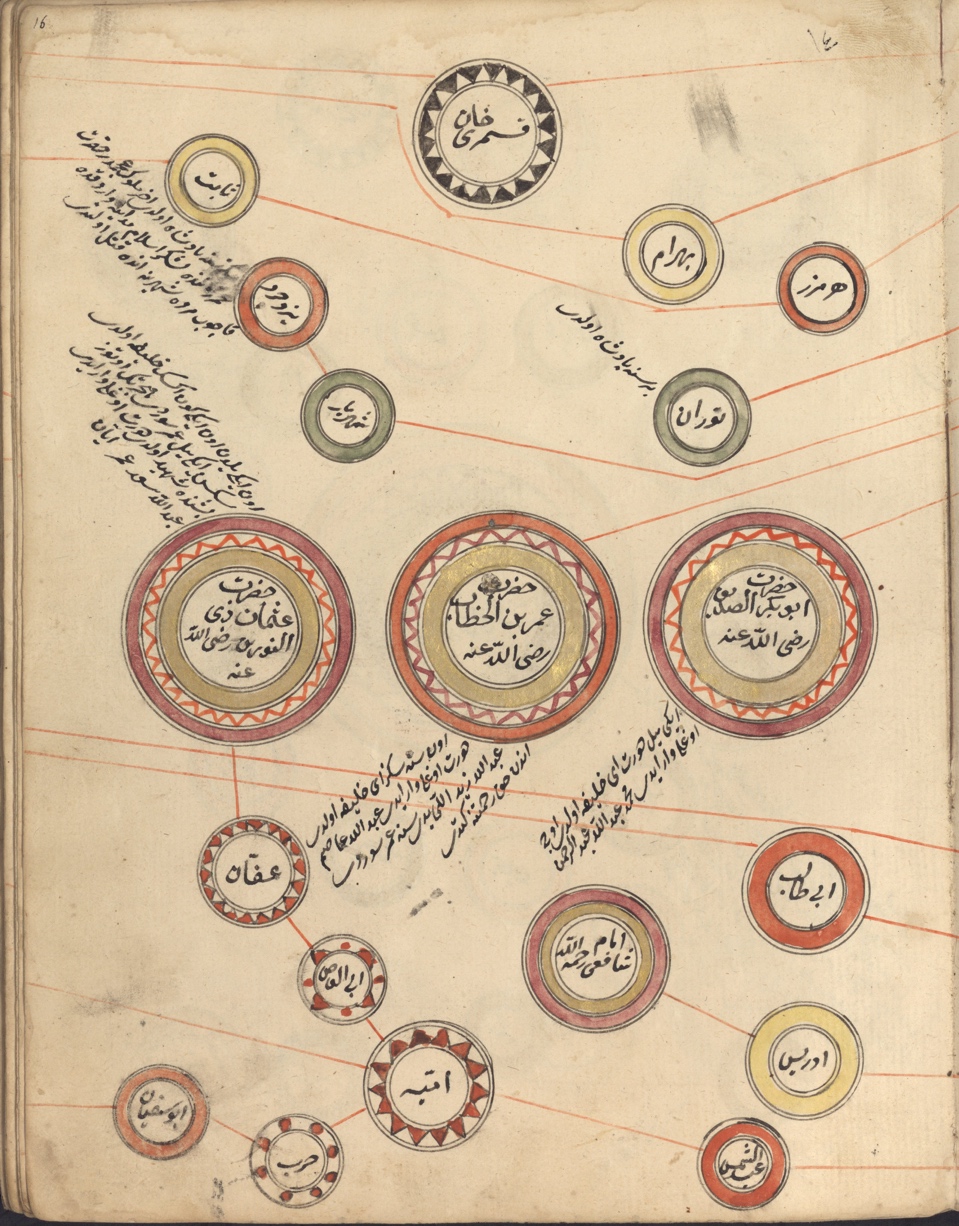
This is not alas an early modern Ottoman visualization of a workflow, digital or otherwise, but it would be pretty cool to use this style and layout to make a workflow chart of digital Islamicate humanities work…</p>

<p>Regardless of how much or how little you may make use of digital workflows in your everyday scholarly work, it is important, arguably even vital, to think about those workflows and what you are actually doing and how you do it, and how digital tools, platforms, methods, and the like might be shaping your work and how you might yourself better shape or modify them to suit your larger goals and intentions. And we at OpenITI want to help you, wherever you are on the spectrum of <em>de facto</em> digital humanist, make better use of the digital world, to understand your own workflows and digital environments better, and to become aware of other tools and possibilities and their benefits and drawbacks, whether or not you decide to use them. Towards that end we are starting a “listening campaign” to get a better feel for where our colleagues are these days; among our goals will be a journal article describing the results of this campaign, but most important is our desire to better understand how our own work and efforts can meet the needs of students and scholars from across the Islamicate humanities, from those who are still mostly analog to those who work effortlessly from the command line.</p>

<p>So, wherever you might be in the world of digital possibilities, we’d like to hear from you about your experience and personal history in the digital world. Here's the “workflow” we’re envisioning: if you are interested in participating, we can do a couple of different things. We’d love to have face-to-face (mostly likely virtually given the global distribution of our field!) interviews with folks, but we’re also perfectly fine with written communication. Here are some of the sorts of questions we’d like to ask (and we’ll be refining these questions for circulation to interested participants a bit later on):</p>

<p>What kinds of digital tools do you use? Search engines, catalogs, online textual repositories? Do you work at the command line? What kind of word processor or note-taking applications do you use? How much of your daily reading is via electronic books, PDFs, digitized manuscripts? How do you manage your time online during the working day? Do you have a social media presence that is some way connected to your scholarly work? I’ll also encourage contributors to add a paragraph or two reflecting on how their digital scholarly habits have changed over time, and to what degree digital environments have shaped their other scholarly habits, for good or ill or in basically neutral fashion (for an idea of what I’m talking about, see for instance <a href="https://jonathanparkesallen.substack.com/p/on-digital-writing-and-the-making">an essay that I recently published on my personal website</a>). I suspect that many of us have a habit of downloading far more journal articles than we can actually read, and may even find ourselves mired in indecision or our attention divided by moving back and forth among competing digital media while ostensibly reading one text. How do you deal (or not!) with information/knowledge management at the scales afforded by digital technology?</p>

<p>We’ll incorporate your answers—with your permission of course—into the eventual article, and will provide the option for anonymous submission (if say you’d like to confess how many hours you spend on the platform formerly known as Twitter), though I would encourage contributors to attach their names to their submissions, whether you regard your digital workflows and habits as cutting-edge or thoroughly quotidian. Seeing how we all operate, including the challenges and shortcomings we encounter, the things we’d like to fix, and the resources we wish we had, are all important for the health and flourishing of our various related fields of study and communities of learning and interaction.</p>

<p>If you’d like to participate, please send me (<a href="mailto:jallen22@umd.edu">jallen22@umd.edu</a>) or Taimoor Shahid (<a href="mailto:tshahid@umd.edu">tshahid@umd.edu</a>) an email and we’ll get back with you to do either a Zoom interview or a written questionnaire (or both if you prefer!).</p>]]></content><author><name>Jonathan Parkes Allen</name></author><summary type="html"><![CDATA[Something one often hears in the context of introductions to or apologetics for digital humanities is the idea that all scholars today are in some degree or another "digital humanists." And while it sounds at this point a bit cliché, it is in fact true: just about everyone who works...]]></summary><media:thumbnail xmlns:media="http://search.yahoo.com/mrss/" url="/images/blogs/2024-02-19/Introducing-Our-Survey-of-Digital-WorkflJonathan%20Parkes%20Allen/media/image1.jpeg" /><media:content medium="image" url="/images/blogs/2024-02-19/Introducing-Our-Survey-of-Digital-WorkflJonathan%20Parkes%20Allen/media/image1.jpeg" xmlns:media="http://search.yahoo.com/mrss/" /></entry><entry><title type="html">A New Journal of Islamicate DH and A Proposal for an Article Workshopping Group</title><link href="/2024/02/02/A-New-Journal-of-Islamicate-DH-and-A-Pro.html" rel="alternate" type="text/html" title="A New Journal of Islamicate DH and A Proposal for an Article Workshopping Group" /><published>2024-02-02T00:00:00+00:00</published><updated>2024-02-02T00:00:00+00:00</updated><id>/2024/02/02/A-New-Journal-of-Islamicate-DH-and-A-Pro</id><content type="html" xml:base="/2024/02/02/A-New-Journal-of-Islamicate-DH-and-A-Pro.html"><![CDATA[<p>My OpenITI colleague Taimoor Shahid and I were recently able to—virtually—sit down and have a productive conversation with Eid Ahmed Mohamed and Mai Zaki, the editors of the quite newly launched (first issue comes out in a couple of months) <em><a href="https://brill.com/view/journals/jdir/jdir-overview.xml?language=en">Journal of Digital Islamicate Research</a></em>, discussing their vision for the journal and exploring ways that we at OpenITI might be able to help bring diverse scholarly voices into wider conversation via publication in this imprint. Based on our conversation with Mai and Eid this journal really has the potential to be an important platform for not only aggregating the work of scholars working in Islamicate DH (very broadly understood) but also as a way of making that work more widely visible to other fields and disciplines. We’d like to put in a plug for the journal and encourage anyone, but in particular people working on topics in Persian, Ottoman Turkish, Urdu, and other vernacular languages to reach out to the editors if you have material that might fit with the goals of the journal.</p>

<p class="figcaption"><a href="/images/blogs/2024-02-02/A-New-Journal-of-Islamicate-DH-and-A-ProJonathan%20Parkes%20Allen/media/image1.jpeg"><img src="/images/blogs/2024-02-02/A-New-Journal-of-Islamicate-DH-and-A-ProJonathan%20Parkes%20Allen/media/image1.jpeg" alt="" /></a>
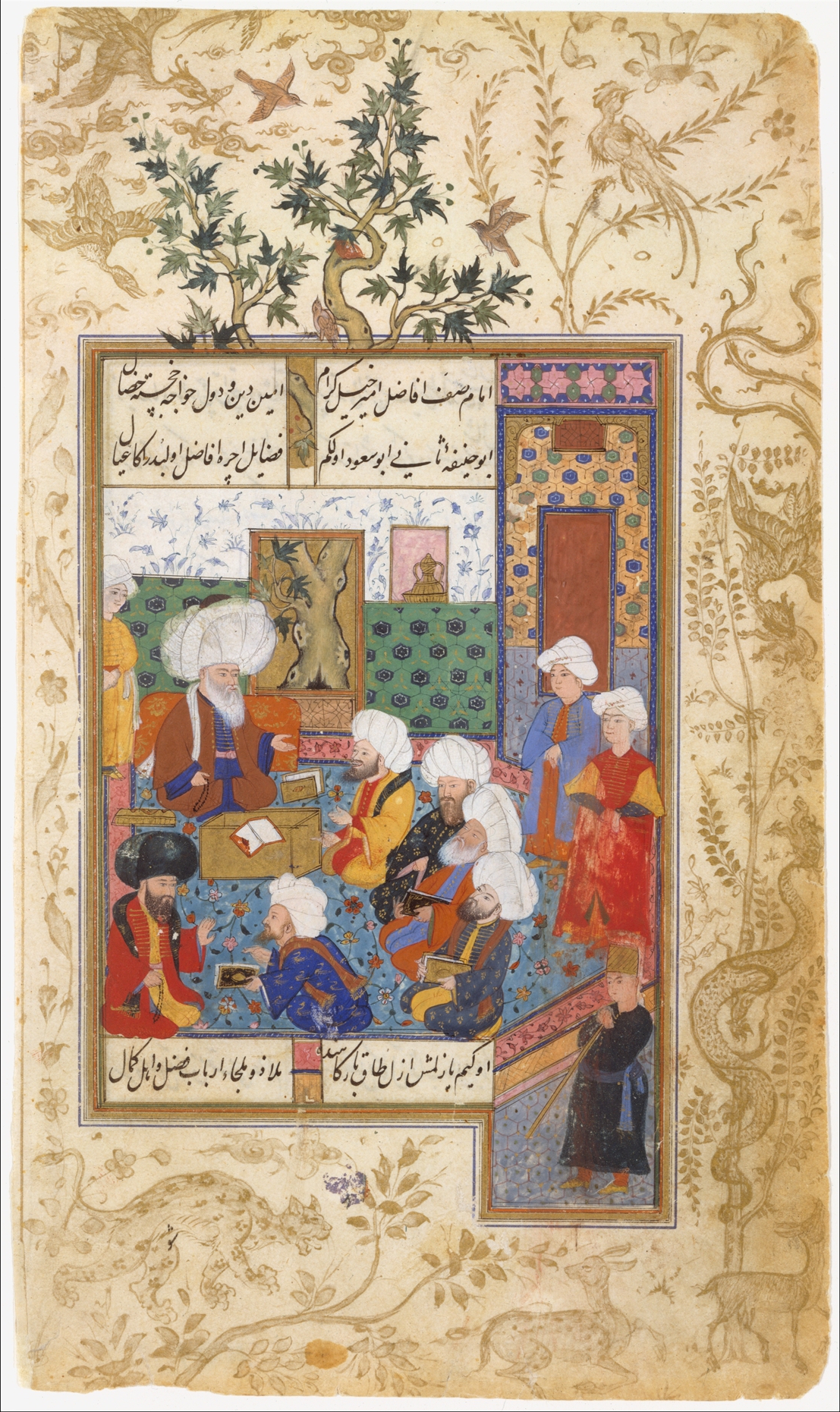
An Ottoman discussion circle c. 1600, the ancestor more or less of our virtually hosted reading and workshopping groups! Metropolitan Museum of Art, 25.83.9</p>

<p>As part of our goal of building long-term sustainable communities of users and practitioners of digital Islamicate humanities, we at OpenITI want to see more scholars from more fields and from more regions of the world able to articulate and present their work in academic forums. Journals like the <em>Journal of Digital Islamicate Research</em> are obviously a key part of realizing such a vision, but there are many other things that we and others can be doing. Towards that larger goal, one of the things we’d like to do in the coming months is to begin <strong>a monthly or even bi-monthly workshopping group for scholars</strong> at all levels—graduate, post-grad, junior and senior faculty—working on articles for publication or on other forms of public presentation of their work (which could range from dissertation chapters to conference presentations to online essays). The workshopping group would be held virtually, ensuring that scholars from around the world could participate, and would incorporate work at various stages of competition (or lack thereof!). It would be especially helpful to have individuals with prior experience publishing in DH venues or on related topics to participate. We would also be able to help with issues of framing, structure, and provide some editorial-style guidance and interventions, particularly for writers looking to publish for the first time in an English-language venue.</p>

<p>If you have an Islamicate DH project in which you’ve participated, a topic of research that is in some way DH related, or really have anything that is broadly congruent with the work and goals of OpenITI about which you’re interested in writing a journal article (whether for the <em>Journal of Digital Islamicate Research</em> or for various other outlets) or something similar and would like feedback and guidance during the process, <strong>we encourage you to reach out to us</strong>. You can email me directly at <a href="mailto:jallen22@umd.edu">jallen22@umd.edu</a>, or message me on Twitter (via my personal account is best, \@mar_musa); even if you’re just thinking about writing an article or are in the very preliminary stages this group would still work for you, and I would like to go ahead and gauge likely interest before deciding on dates, times, and precise format. We’ll make a further announcement in this space and on Twitter once we’ve finalized the details, so stay tuned!</p>]]></content><author><name>Jonathan Parkes Allen</name></author><summary type="html"><![CDATA[My OpenITI colleague Taimoor Shahid and I were recently able to---virtually---sit down and have a productive conversation with Eid Ahmed Mohamed and Mai Zaki, the editors of the quite newly launched (first issue comes out in a couple of months) *Journal of Digital Islamicate Research*, discussing their vision for the...]]></summary><media:thumbnail xmlns:media="http://search.yahoo.com/mrss/" url="/images/blogs/2024-02-02/A-New-Journal-of-Islamicate-DH-and-A-ProJonathan%20Parkes%20Allen/media/image1.jpeg" /><media:content medium="image" url="/images/blogs/2024-02-02/A-New-Journal-of-Islamicate-DH-and-A-ProJonathan%20Parkes%20Allen/media/image1.jpeg" xmlns:media="http://search.yahoo.com/mrss/" /></entry><entry><title type="html">Introducing the ACDC Project, Part I: Training Data Production and the Diversity of the Islamicate Manuscript Tradition</title><link href="/2024/01/05/Introducing-the-ACDC-Project-Part-I-Tr.html" rel="alternate" type="text/html" title="Introducing the ACDC Project, Part I: Training Data Production and the Diversity of the Islamicate Manuscript Tradition" /><published>2024-01-05T00:00:00+00:00</published><updated>2024-01-05T00:00:00+00:00</updated><id>/2024/01/05/Introducing-the-ACDC-Project--Part-I--Tr</id><content type="html" xml:base="/2024/01/05/Introducing-the-ACDC-Project-Part-I-Tr.html"><![CDATA[<p>One of OpenITI’s major deliverables in our most recent round of work is the <a href="https://openiti.org/projects/ACDC.html">Automatic Collation for Diversifying Corpora</a> (ACDC) project and ensuing tool, which we are now making available for wider use and experimentation: the relevant <a href="https://github.com/OpenITI/acdc_train/">code and instructions for installation and use are available on Github</a>, and additional data and documentation will be forthcoming. ACDC is one component in our multi-pronged strategy to significantly boost handwritten text recognition for Arabic script as manifest within the manuscript tradition, a tradition of text production that dates from around the time of the Qur’an’s codification all the way down to the present (in some parts of the Islamicate world manuscript production for various purposes remains very much alive!). In this week’s blog entry, I’d like to briefly introduce the project (or, rather, allow one of our other team members do so), then focus on one aspect of its production: the creation of training data via selection of a limited manuscript corpus and then manual transcription of exemplars from that corpus. We’ll see the rationale that lay behind our selections, and in so doing get a valuable glimpse of the immense diversity (and, from a technical standpoint, challenges!) of the Islamicate manuscript tradition, and reflect on the nature of ‘canonicity’ in Islamicate texts and the multiple forms of use that these manuscripts underwent in their ‘working lifetimes.’ We’ll return to ACDC later in the spring semester, as we explore its capacities more and finish documentation and archiving of the relevant data.</p>

<p>Our team member David Smith (Northeastern University), the main driver behind the ACDC project, has just released a video introduction and tutorial to the project and the ensuing tool, <a href="https://youtu.be/kNx4GyH5HSo?si=i1on3aT3lgUbEyT0">wherein he explains the logic of the project and gives a detailed walk-through of use, do have a watch</a>!</p>

<p class="figcaption"><a href="/images/blogs/2024-01-05/Introducing-the-ACDC-Project--Part-I--TrJonathan%20Parkes%20Allen/media/image1.jpg"><img src="/images/blogs/2024-01-05/Introducing-the-ACDC-Project--Part-I--TrJonathan%20Parkes%20Allen/media/image1.jpg" alt="" /></a>
Library of Congress PK6450 .G2 1593</p>

<p>My primary contribution to this project was in leading the production of training data: while the goal of ACDC is to limit the amount of necessary training data for the production of valuable HTR through its text alignment method, in order to construct the tool itself some training data was necessary, albeit not on the same scale as our previous work on optical character recognition (thank goodness, as manuscript transcription is a whole other order of difficulty!). Our goal in compiling a training data set was to reflect the internal diversity of the Islamicate manuscript tradition as manifest in particular texts common across the corpus, existing in many copies, and hence especially useful for training the alignment method. We wanted to have script diversity, obviously, meaning texts that could be found from the Maghrib to southeast Asia, but we also wanted a good representation of layout diversity, from multi-column poetry to extensive marginal annotations, many lines per page to a few widely spaced ones, and so forth. This meant identifying and then collecting many examples of texts that obtained a ‘canonical’ status in medieval and early modern Islam (primarily, though not all of these texts were of an exclusively Islamic nature). What do we mean by ‘canonical’ in these cases? Perhaps it would be better to demonstrate via an exploration of the five-text corpus we chose to structure our training data set, as each text became canonical for different reasons, with the manuscripts of these texts displaying the particular forms of use that canonicity involved, and through which it was generated.</p>

<p>Perhaps the most visually striking text in terms of layout in our corpus comes from copies of Sa’d al-Dīn al-Taftāzānī’s <em>Sharḥ al-ʻAqāʼid al-Nasafīya</em>. One of if not the most important theological introductory texts of the late medieval into early modern Islamicate world, al-Taftāzānī’s commentary on the short <em>‘aqā’id</em> (‘creed’ as it is often translated, albeit not precisely accurately) text of the medieval theologian Abū Ḥafṣ 'Umar al-Nasafī elaborated further on the principles of Islamic philosophical theology, with many later authors adding their own super-commentaries to al-Taftāzānī’s initial <em>sharḥ</em>. We chose this text not just because it exists in many, many copies, having become a mainstay of madrasa ‘curriculum’ across the Islamicate lands (but especially in the Ottoman world), but also because like many such texts employed in a madrasa context, it is often very complex layout-wise, composed with wide interlinear space and ample margins, both elements designed for additional annotation by students or for the addition of marginal commentary. And like other typical madrasa texts, the overwhelming majority of manuscript copies are decidedly non-prestige, featuring no illumination or decoration, employing scribal hands of a very ‘workaday’ mien, and hence encompassing a great deal of diversity given the chronological and geographic reach of this text.</p>

<p class="figcaption"><a href="/images/blogs/2024-01-05/Introducing-the-ACDC-Project--Part-I--TrJonathan%20Parkes%20Allen/media/image2.png"><img src="/images/blogs/2024-01-05/Introducing-the-ACDC-Project--Part-I--TrJonathan%20Parkes%20Allen/media/image2.png" alt="" /></a>
Leipzig B. Or. 156.01</p>

<p>While a widespread text due to its mainstay nature on the madrasa cirriculum, in sheer numbers al-Taftāzānī’s <em>sharḥ</em> is easily overtaken by what might well be the most copied pre-modern Arabic text after the Qur’ān, Muḥammad al-Jazūlī’s prayerbook (not the most apt translation but it will do for the moment) <em>Dalā’il al-khayrāt</em>, perhaps the most important single text in the history of Islamic devotional practice, a importance reflected in the vast number of copies in existence. Alone among the five texts in our corpus, manuscripts of the <em>Dalā’il</em> can be found quite literally everywhere Islamicate manuscripts were produced, from the westernmost edge of Africa all the way to eastern China; while rare in the Iranian lands there are occasional copies. Aside from the Qur’ān it is hard to think of any text with such geographical and chronological reach, ubiquity which is visible in the internal diversity of the text’s manuscript tradition. While <em>naskh</em> predominates as the script of choice, and many prestige copies exist, other scripts and iterations of hands, refined and rough, exist; likewise, while some Dalā’il copies are lavishly illustrated with devotional imagery, many have the bare minimum, and some have no imagery at all. Marginal texts, interlinears, and the like are common, but not universal, given that they are not strictly necessary for the primary uses of this text. Rather, this text functioned as a means of performing <em>taṣliya</em> upon Muhammad and eliciting blessings for the reciter; it also functioned in a physically prophylactic way, akin to talismanic texts or to other, later forms of devotional art and composition. Many of the images of Mecca and Medina, which early on became near universal mainstays of the text, have evidence of tactile engagement: rubbing and kissing, both means of obtaining <em>baraka</em> from these images. As both a driver of and beneficiary of the ‘devotional turn’ of late medieval and especially early modern Islam, the <em>Dalā’il</em> came to occupy by far the most diverse range of physical settings, from modest private homes to the most exalted sultanic libraries and foundations. The relatively rapid movement towards canonicity in this case was facilitated by the proliferation of multiple forms of use for these manuscripts, ranging from public ritual performance to private household reading/recitation to physical presence and tactile participation.</p>

<p class="figcaption"><a href="/images/blogs/2024-01-05/Introducing-the-ACDC-Project--Part-I--TrJonathan%20Parkes%20Allen/media/image3.png"><img src="/images/blogs/2024-01-05/Introducing-the-ACDC-Project--Part-I--TrJonathan%20Parkes%20Allen/media/image3.png" alt="" /></a>
Bibliothèque nationale de France, Arabe 6983</p>

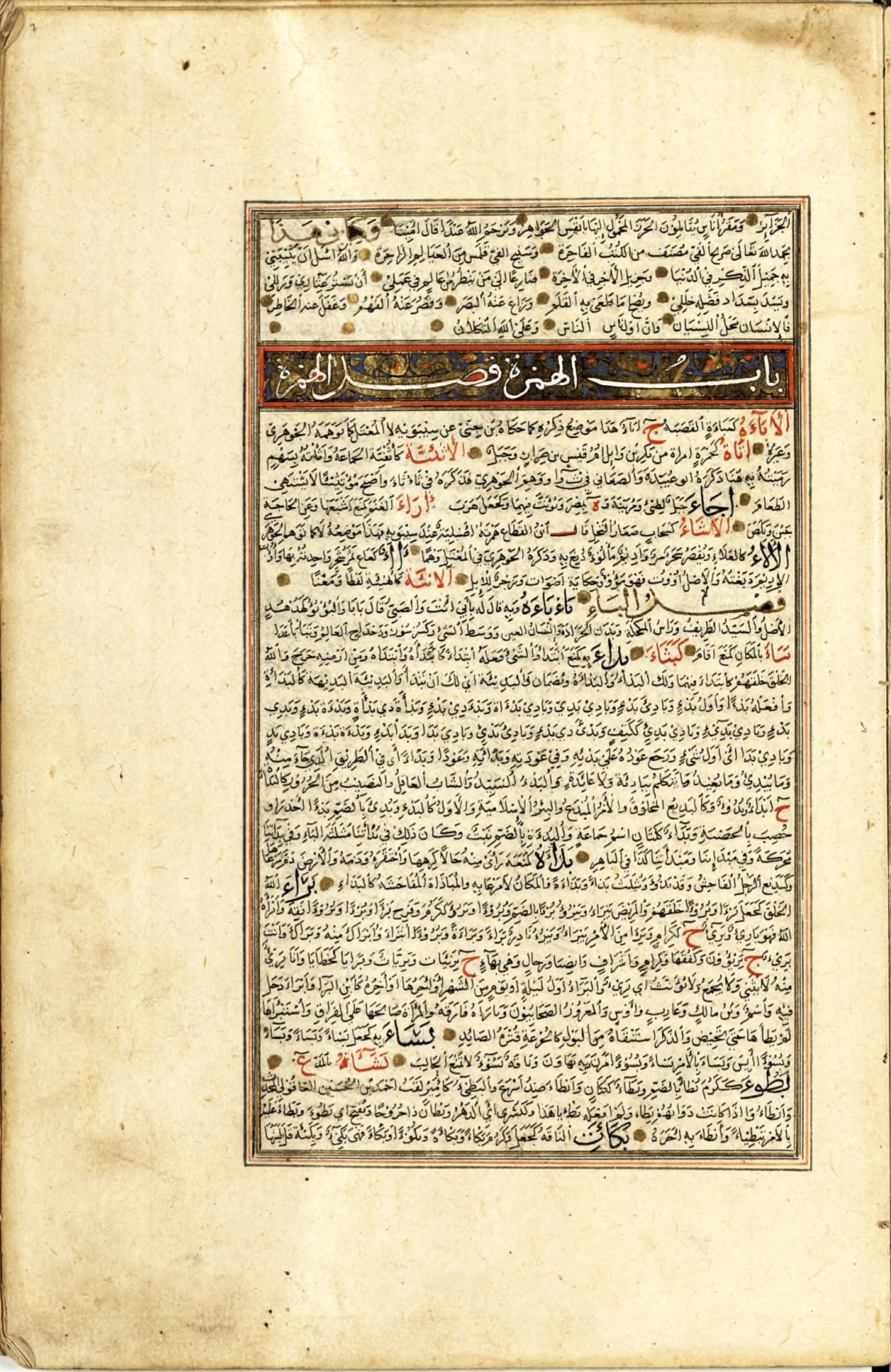
<p>Our third Arabic text represents yet another route to canonicity, in this case not closely tied to Islam qua religion: al-Fīrūzābādī’s truly oceanic Arabic language dictionary, <em>al-Qāmūs al-muḥīṭ</em>. Despite being a massive text, this lexical compendium was widely copied and housed in a surprisingly diverse range of institutions, making its way into Christian libraries as well as those of mosques and madrasas, reflecting shared cultural contours of Arabic culture in the pre-modern world. Its essentially reference work nature can be seen in the layout style: while there are various interesting paratextual interventions built into these copies (larger point sizes to identify the various word entries and the like), there is little to no marginal annotation or other forms of intervention outside of or parallel to the main text. Most notably, the pages of these manuscripts tend to be absolutely packed with text, containing the highest number of lines and words out of our five text corpus; I noted a higher rate of obvious scribal errors, especially reduplication of words and lines, no doubt as a result of the density of text spacing as well as the fact much of the material is linguistically obscure, filled with roots and morphologies of rare occurrence in Arabic literature. It was this comprehensiveness and utilitarian (though not strictly so) cast that helped to make the <em>Qāmūs</em> such a central and pervasive text, despite its semantic complexity and bulk.</p>

<p class="figcaption"><a href="/images/blogs/2024-01-05/Introducing-the-ACDC-Project--Part-I--TrJonathan%20Parkes%20Allen/media/image4.png"><img src="/images/blogs/2024-01-05/Introducing-the-ACDC-Project--Part-I--TrJonathan%20Parkes%20Allen/media/image4.png" alt="" /></a>
University of Michigan, Islamic Ms. 221</p>

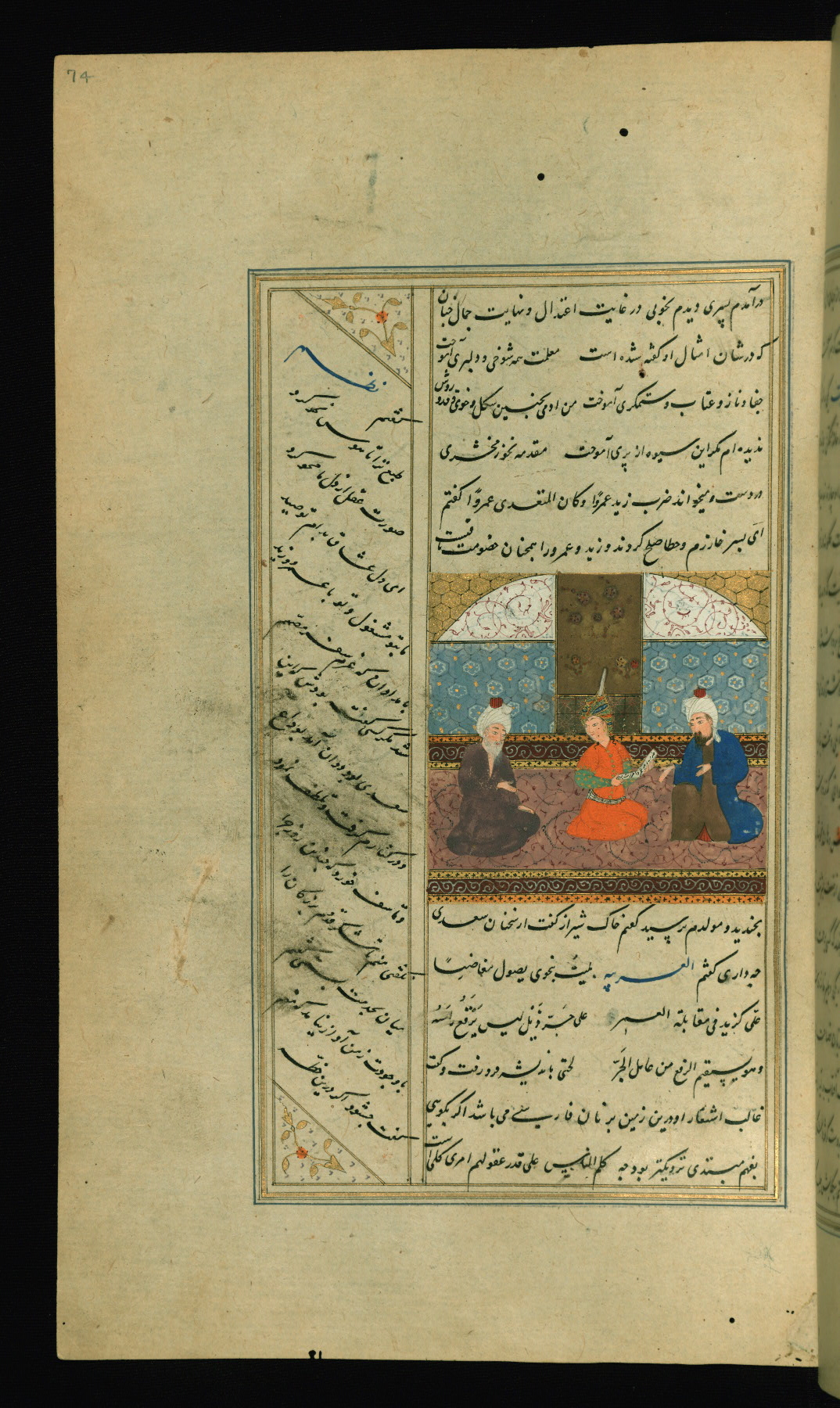
<p>Alongside the previous three Arabic texts we selected two Persian texts (for this project we limited ourselves to those two languages due to the sheer number of manuscripts in both, followed by Ottoman Turkish and, in time, Urdu), one of poetry, the other primarily of prose, both circulating not just in the historically Iranian lands but far beyond in the global ‘Persianate.’ Especially redolent of the far reach of Persian and its status as a language of cultivation is the famous <em>Gulistān</em> of Sa’dī, a broadly moralistic work of stories and lessons, written in what we might describe as poetic prose. Its canonical status was generated not just by appreciation for its contents and their moral instructional value but even more by the utility of this text for learning Persian. As such many surviving manuscripts have a similar layout to copies of al-Taftāzānī’s <em>sharḥ</em>, reflecting, if not a madrasa context, something very similar in Persian language learning environments (which might have taken place in a sufi <em>tekke</em> or in the private home of a scholar, less often in madrasas themselves). Interlinears in Ottoman Turkish are especially common, as this was the primary text for the learning of Persian among Turkish speakers in the early modern world. Unlike al-Taftāzānī’s <em>sharḥ</em>, prestige copies of the <em>Gulistān</em> also exist, as its canonicity, while underlined by its pedagogical role, was more broadly based. It was a text that graced the libraries of the elite, and thus attracted extensive illumination and illustration programs, examples of which we included in our data set.</p>

<p class="figcaption"><a href="/images/blogs/2024-01-05/Introducing-the-ACDC-Project--Part-I--TrJonathan%20Parkes%20Allen/media/image5.jpeg"><img src="/images/blogs/2024-01-05/Introducing-the-ACDC-Project--Part-I--TrJonathan%20Parkes%20Allen/media/image5.jpeg" alt="" /></a>
Walters Art Museum, Walters Ms. W.617</p>

<p>Finally, in order to represent the Persian poetic tradition, we selected one of the most famous and deeply culturally embedded compilations of Persian poetry, the <em>Dīvān</em> of Ḥāfiẓ, a work with especially powerful resonances in the Iranian lands, though it too like the <em>Gulistān</em> circulated far beyond Persian-speaking regions and was a central element of wider Persianate culture. Much like <em>Dalā’l al-khayrāt</em>, the <em>Dīvān</em> would become something of a household fixture, and not just among the elite, often acting as an object of festive bibliomancy, a role it still occupies today in fact. In terms of layout features, the <em>Dīvān</em> is a good example of the use of ‘pseudo-columns’ in Islamicate poetry: columns that are primarily aesthetic, as they read continuously across the page (and so unlike several other linguistic/script traditions in the wider Islamicate world, such as Syriac or Ge’ez, in which true columns were the norm, even in prose). These pseudo-columns, often broken in two with illumination, pose real challenges to layout models and particularly to line extraction, issues among others we are continuing to work on resolving. The <em>Dīvān</em> also frequently features slanting text blocks and other complicated features, part of a general transformation towards greater complexity and proliferation of features that we see across the Arabic script manuscript tradition from the late medieval period forward, culminating in anthology-style texts with smply absurd numbers of discrete text blocks arranged, puzzle-like, onto a single page. None of our samples from the Dīvān tradition have quite that level of complexity, but all have at least some of the distinctive features that came to be associated with poetic—especially Persian poetic—texts.</p>

<p class="figcaption"><a href="/images/blogs/2024-01-05/Introducing-the-ACDC-Project--Part-I--TrJonathan%20Parkes%20Allen/media/image6.jpeg"><img src="/images/blogs/2024-01-05/Introducing-the-ACDC-Project--Part-I--TrJonathan%20Parkes%20Allen/media/image6.jpeg" alt="" /></a>
University of Michigan, Islamic Ms. 316</p>

<p>All of these texts posed their own particular challenges in terms of transcription and layout analysis, with the latter an especially tricky continuing issue. Speaking personally, navigating a very wide range of scripts and hands was not always easy, though the fact that we were working on fairly stable canonical texts certainly helped, since I could have reference to other manuscript copies to help clarify paleographic difficulties (the question of textual stability and its relationship, or lack thereof, to canonicity is a whole other matter for another time). And while the data set we assembled is indeed diverse, drawn from across time and space, there are still limitations: virtually all of the material is of early modern provenance, for instance, even though all of the texts are strictly speaking of a medieval date in terms of composition. Because of our focus on specific texts for alignment between multiple copies, we did not include <em>majmū’a</em>s with their often distinctive styles of layout and manuscript hand features; while overall legibility certainly varied within our corpus none had the, for lack of a better term, scrawly cast so common in <em>majmū’a</em>s, intended as many of them were for largely person consumption. In recognition of those limitations we later developed an extensive evaluation set, pulling from all manner of texts, periods, styles, and so forth, including those under-represented or not represented at all in our training data set; perhaps aspects of that work will feature in a future blog post.</p>

<p>It's also worth noting that we drew upon a somewhat restricted range of digitized manuscript repositories due to download restrictions: everything in this particular data set has been taken from sources that permit full downloads of digitized texts, either via PDF, IIIF, or individual image formats. This precludes repositories such as the British Library or the Hill Manuscript Museum and Library which, for varying reasons, prohibit or restrict downloads, requiring in-domain viewing. We also decided to exclude downloaded material available to us that was not of a strictly licit nature—meaning, primarily, the widely circulated digitized contents of a certain major manuscript collection in the former capital of the Ottoman Empire. Because everything we incorporated is freely available, we will be able to make every aspect of our data openly available once we are finished archiving everything (I’ll update here with links once that process is complete). Limitations in repository availability (and coverage) meant that some regions were definitely under-represented: while we were able to draw upon some West African material via the Bibliothèque nationale de France, the considerably larger digital archives from the region were not available to us for this project; East Asian material was also lacking, due to its limited digitization. And in retrospect, I should have scoped out more Southeast Asian material, much of which is available (with a great deal more contained within in-domain only viewing repositories).</p>

<p>Finally, a personal note: it was a real pleasure (well, most of the time) compiling and transcribing the two manuscript data sets that went into this project, as it involved exploring corners of the Islamicate manuscript tradition I had not really seen before. Unlocking more and more of the diversity of this vast tradition is one of the primary goals of OpenITI, encouraging and enabling more people to navigate these riches and to make use of what is contained therein; if tools like ACDC help to encourage manuscript exploration and use even a little then we will count that as a step forward in the right direction.</p>]]></content><author><name>Jonathan Parkes Allen</name></author><summary type="html"><![CDATA[One of OpenITI's major deliverables in our most recent round of work is the [Automatic Collation for Diversifying Corpora](https://openiti.org/projects/ACDC.html) (ACDC) project and ensuing tool, which we are now making available for wider use and experimentation: the relevant [code and instructions for installation and use are available on Github](https://github.com/OpenITI/acdc_train/), and additional...]]></summary><media:thumbnail xmlns:media="http://search.yahoo.com/mrss/" url="/images/blogs/2024-01-05/Introducing-the-ACDC-Project--Part-I--TrJonathan%20Parkes%20Allen/media/image1.jpg" /><media:content medium="image" url="/images/blogs/2024-01-05/Introducing-the-ACDC-Project--Part-I--TrJonathan%20Parkes%20Allen/media/image1.jpg" xmlns:media="http://search.yahoo.com/mrss/" /></entry><entry><title type="html">The Year in Review: Reflections on OpenITI Pedagogy and Outreach in 2023</title><link href="/2023/12/18/The-Year-in-Review-Reflections-on-OpenI.html" rel="alternate" type="text/html" title="The Year in Review: Reflections on OpenITI Pedagogy and Outreach in 2023" /><published>2023-12-18T00:00:00+00:00</published><updated>2023-12-18T00:00:00+00:00</updated><id>/2023/12/18/The-Year-in-Review--Reflections-on-OpenI</id><content type="html" xml:base="/2023/12/18/The-Year-in-Review-Reflections-on-OpenI.html"><![CDATA[<p>As 2023 draws to a close, I wanted to use this last blog post of the year to reflect on OpenITI’s pedagogical and outreach work, or at least the parts with which I have been closely associated. Over the course of the last year, I put together and oversaw two reading and working groups, taught our summer digital paleography and codicology course, and, for part of the year, ran our Twitter account and sought to revitalize this blog. Some of those endeavors were more successful than others, and in what follows I’m both highlighting my own shortcomings working in this outreach and pedagogy space while also thinking through the common thread of all of these things, namely their taking place in online spaces and through various digital media. This post will serve as documentation of these efforts, and hopefully provide some useful material with which to think about future projects along similar lines.</p>

<p><a href="/images/blogs/2023-12-18/The-Year-in-Review--Reflections-on-OpenIJonathan%20Parkes%20Allen/media/image1.png"><img src="/images/blogs/2023-12-18/The-Year-in-Review--Reflections-on-OpenIJonathan%20Parkes%20Allen/media/image1.png" alt="" /></a></p>

<p>Our longest-running outreach project this year was the series of reading and working groups I organized for both the spring and fall semesters, and which will continue into next year. For fall 2022 into spring 2023 our theme was the broad history of Islamicate textual technologies, stretching from the origins of Arabic script in antiquity all the way to the digital age; speaking only for myself, this was a fascinating journey, opening vistas into topics with which I had only vague prior familiarity. In both this and the fall reading group we have had global participation from individuals in various positions and many different institutional settings; indeed one of the more important challenges has been finding a time of day that can accommodate people in every corner of the world (on this front I am always amazed and inspired by people who are able to meet in the late hours of the night and still contribute to the conversation!). For the fall reading group, my original plan was to have two separate sessions, one for Persian and Urdu readers, the other for Arabic and Ottoman Turkish readers, with some secondary literature reading and a mix of direct manuscript reading and transcription and annotation work. This proved somewhat harder to execute than I had envisioned in my head, and over the course of the fall we ended up spending more time on secondary source literature, really serving as an introduction to Islamicate codicology and history of the book as it relates to manuscript culture (though we did touch on the emergence of print). We still managed to do a fair amount of direct manuscript examination, though I think we could have done better on this count; my probably over-ambitious idea of producing some digital annotated editions of manuscripts was less successful (though I am hopeful we will return to this project in the spring). For the spring we are changing tack once again, taking a more digital humanities-centric approach, and looking to devote a separate session in the week just to manuscript reading and discussion, focusing on a set of manuscripts for closer and more extensive study.</p>

<p><a href="/images/blogs/2023-12-18/The-Year-in-Review--Reflections-on-OpenIJonathan%20Parkes%20Allen/media/image2.png"><img src="/images/blogs/2023-12-18/The-Year-in-Review--Reflections-on-OpenIJonathan%20Parkes%20Allen/media/image2.png" alt="" /></a></p>

<p>Our most intensive project this year was our summer digital Islamicate paleography and codicology course, in which we invited (out of many, many applications) five graduate students at a range of institutions to participate in an intensive course of readings, discussion, and transcription work using the eScriptorium platform. This was the second time I ran this course, with much more success I would say thanks to the power of hindsight—for instance, we had realized that trying to fit everything into one day a week was simply too much, so this year we divided sessions into Tuesday and Thursday meetings, which was a much better arrangement. Another marked improvement was in our making the students’ work more focused: this year students contributed to our multi-witness manuscript text project, picking a text upon which to focus (in some cases something they were already working on, in other cases something discovered in the course of the summer school) and locating manuscripts which they then transcribed. We also made better use of our Slack workspace this time around, with students actively posting and interacting on the various channels, including material only tangentially related to course material, with such discussion and interaction an important component to an intensive course, but often hard to replicate remotely. In particular, students did a fine job of using Slack to discuss paleographic difficulties and codicological questions, sharing images and files and highlighting problems encountered as well as interesting features. Unfortunately, because we were on the free tier of Slack, the record of our interactions is now locked away behind a paywall… We were also able to work through some of the issues inherent in eScriptorium with collaborative work, though there as well there is room for improvement. On the whole I was very pleased with this summer session, both in terms of mistakes corrected from my previous time running it and in terms of our students, who brought a wonderful diversity of geographic, chronological, and thematic approaches to the course as well as mutually complementing bases of knowledge in both Islamicate history and in digital humanities.</p>

<p>While we did not feature as many invited speakers this year as in the previous iteration, it was still nice to have folks from the outside come on and provide expertise and experience that I lack; likewise, we were fortunate in our reading groups to have some excellent invited speakers, and in the coming year I hope to integrate outside presenters more often, both within established instructional settings and via video/podcast options (on which see below).</p>

<p><a href="/images/blogs/2023-12-18/The-Year-in-Review--Reflections-on-OpenIJonathan%20Parkes%20Allen/media/image3.png"><img src="/images/blogs/2023-12-18/The-Year-in-Review--Reflections-on-OpenIJonathan%20Parkes%20Allen/media/image3.png" alt="" /></a></p>

<p>Finally, about mid-way through the year or so I took over the OpenITI Twitter account and began a campaign of regular blog posts on this website. The latter has continued more or less on schedule, helped along by guest posts by some of our summer course students (a form of engagement I wish I had utilized more extensively, in fact; I would love to see more guest posts, and if anyone out there reading this is interested in contributing do let me know!). I’ve largely restricted my use of our Twitter account to post updates concerning OpenITI, link to blog posts, and to retweet relevant material from colleagues and adjacent organizations. This is one area I’m not entirely satisfied that our level and mode of engagement and outreach is sufficient: I suspect that it would be a good idea to include more ‘original content,’ something that I try to do regularly on my personal Twitter account, where I have found, to my happy surprise, that manuscript-related posts are often quite popular, circulating far and wide in the Twitterverse. Of course, as even non-users will no doubt be aware, Twitter (technically ‘X’) is not without its problems, though the expectation of imminent doom have subsided considerably in recent months (no doubt in part due to considerably more pressing large-scale problems than the relative health of a social media website). While many people who at some point during the new owner’s tenure migrated away to other platforms, my sense is that many have found their way back (my own foray on a competitor platform has since gone inactive…). That said, the available audience has certainly fragmented somewhat, and to be totally honest I’ve no desire to maintain accounts with engagement on multiple platforms (beyond the possibility of an Instagram account, which we might open this spring).</p>

<p>In terms of other platforms/media, I had planned to record and post podcast-style interviews with various people working in the area of Islamicate DH; this is the one area of outreach in which, for this year at least, I met defeat. I am still aiming on expanding in this area come spring, as I do think that online talks, interviews, and the like fulfill a need that text-heavy material (my native domain, to be sure) does not. In terms of platform, at present we host our video and audio material on YouTube, but this is an area in which I am open to additional suggestions and experimentation.</p>

<p>Turning now to broad lessons learned and issues encountered: at the risk of sounding a bit cliché given that this is hardly a new topic anymore, teaching and interacting with other scholars and members of the public virtually has both its rewards and its downsides. The greatest upside of online meeting spaces is one that we risk losing sight of as have become so accustomed to it: the ability to bring together in a virtual setting people from literally opposite sides of the planet, and to do so in real-time, seeing one another’s faces (and, in my case at least, one’s cats and/or children from time to time!) and speaking to one another, all without requiring expensive (and ecologically and climatically fraught) travel to some conference or workshop halfway around the world. Now, such interactions are not a replacement for actual ‘in-person’ interaction and teaching, to be sure, but they are invaluable for reaching people around the world and outside of traditional academic settings. This technological ability is especially important when it comes to areas of study and practice that are, in even major universities, quite niche, such that in many places in-person courses or reading groups on, say, Islamicate paleography and book history, simply could not be viable. As many commentators have begun to notice, the internet broadly is—once again—becoming an important engine of niche development, of allowing small and geographically dispersed communities form and interact, with both positives and negatives when thinking on a larger social scale.</p>

<p>Now for some shortcomings and downsides, some of which are inevitable, some of which can be rectified I think through adjustments, including simply in our expectations. One of the trickiest areas of negotiation, both in our pedagogical and outreach functions as well as in our own team communications, has been the choice of platforms for communication and collaboration. As we are all aware, the modern digital communicative landscape is marked simultaneously by a handful of giants—Google, Twitter, etc—as well as a seemingly infinite array of other platforms, apps, and options. Finding which ones to use, and how to balance the needs and predilections of different colleagues, team members, and people from the ‘general public’ are not easy tasks, and inevitably we end up using bits of this and bits of that, to varying results. It is beyond the scope of this essay, but we have dealt with similar problems and challenges when it comes to data generation, sharing, record-keeping, and so forth, ordinary problems of organization and record-keeping made more complex by the multiplicity of platforms and applications and file types.</p>

<p>Outreach in general faces a challenge familiar to us all: reaching audiences is in many ways an exercise in luck, given the sheer saturation of choices and the relatively random means whereby ‘content’ appears on our screens. It is hard, if not impossible, to keep up with every project, institution, or colleague within one’s orbit; whether it is via social media, email, RSS feeds, or what have you, we are bombarded with content all day every day. This is why maintaining personal relationships and developing and promoting opportunities and spaces for those relationships to arise, is so important, in both the digital realm and in the ‘real world.’ It is here that things like in-person conferences and workshops have so much utility, functioning much as gatherings of otherwise dispersed humans have since at least the late Paleolithic if not before: they are relational and cultural nodes, intense bursts of activity and interaction that can then be perpetuated at a distance once everyone disperses, even if it is only through the sharing and explication of resources and ideas during the time of meeting.</p>

<p>In an ideal world, we would have an expansive budget such that we could gather together dozens of interested graduate students from around the world for our summer course, flying them (with zero carbon footprint!) to some ideal physical location, preferably with easy physical manuscript access, for intensive learning sessions and digital work on different machines but in the same physical space. But such a scenario is simply not realistic, for us at least at this stage (and at present certainly there is no getting around the immense ecological cost of long-distance travel, unless you’re going by sailing ship!). Digitally mediated meeting and pedagogy works well for our concerns, and I am confident that we will continue to improve and to better understand both the allowances and the limitations of virtual meeting and instruction, allowing us to reach people in places that have so often been marginalized or completely overlooked when it comes to Western academia. There are still hurdles and barriers: the sheer breadth and width of our wider field means that we will inevitably have multiple language competencies, with not everyone in a given group able to read in all represented languages (while I am decently competent in Arabic, Persian, and Ottoman Turkish, I have only basic knowledge of Urdu, for instance, and virtually none at all of any number of other vernacular tongues represented in the global manuscript tradition). I am also acutely aware that our language of instruction, English, while having the utility of being now a global lingua franca, means that some participants will struggle more with understanding and communicating their ideas, and that we need to find ways to better accommodate the multi-linguistic nature of our wider field.</p>

<p>Let me conclude just by thanking everyone who participated in and contributed to our reading groups, summer course, and online presence, whether that was regular attendance in a reading group, presentation of recent work, or simply retweeting the OpenITI account. At the risk of sounding a little sentimental—though it is after all almost Christmas—my own experience within the field of Islamicate studies has long been a very positive one, filled with warm and mutually respectful relationships with people from all around the world, united by common interests and concerns and with genuine care for one another. As the future of our fields and of scholarship and humanistic learning widely appears more and more fraught, under the pressure of many different things, our ability to connect with one another and to mutually support and aid one another on both intellectual and quotidian fronts will become more and more crucial. Online means are and will remain for the foreseeable future vital in such work, and the better we can learn to utilize them, the better for our various fields and for each of us as persons.</p>]]></content><author><name>Jonathan Parkes Allen</name></author><summary type="html"><![CDATA[As 2023 draws to a close, I wanted to use this last blog post of the year to reflect on OpenITI's pedagogical and outreach work, or at least the parts with which I have been closely associated. Over the course of the last year, I put together and oversaw two...]]></summary><media:thumbnail xmlns:media="http://search.yahoo.com/mrss/" url="/images/blogs/2023-12-18/The-Year-in-Review--Reflections-on-OpenIJonathan%20Parkes%20Allen/media/image1.png" /><media:content medium="image" url="/images/blogs/2023-12-18/The-Year-in-Review--Reflections-on-OpenIJonathan%20Parkes%20Allen/media/image1.png" xmlns:media="http://search.yahoo.com/mrss/" /></entry></feed>